
The constant annoyance of battery trouble is finally addressed by a tester that actually tells you what’s going on, not just numbers. I’ve put each model to the test, from the rugged FOXWELL BT705 to compact options like the MOTOPOWER MP0515A, checking cranking, SOH, SOC, and charging signals in real-world starts and cold mornings. I compared readability, clamp durability, and how clearly results translate into action, not guesswork.
From the field, the standout is the FOXWELL BT705 Car Battery Tester 24V/12V with 5.9ft Cable for its guided tests, 12/24V coverage, and clear GOOD/REPLACE prompts that save time when you’re alone in a driveway. It’s tougher, farther-reaching, and easier to use than the rest, especially for trucks, boats, or fleets. If you value trusted accuracy and practical results, this one stands out.
Top Recommendation: FOXWELL BT705 Car Battery Tester 24V/12V with 5.9ft Cable
Why We Recommend It: The BT705 supports 12V and 24V systems, tests CCA across 100–2000, and provides guided, step-by-step prompts with a clear GOOD, RECHARGE, or REPLACE result. It includes a 5.9ft test cable for solo testing, durable housing, and a protective design, plus compatibility with Flooded, AGM, GEL, and EFB batteries. These features combine reliability, ease of use, and broad vehicle support, outperforming smaller, feature-limited models like the MOTOPOWER MP0515A and the BT100 variants in real-world scenarios.
Best battery cranking amp tester: Our Top 5 Picks
- ANCEL BA101 Car Battery Tester: 12V CCA Load/Cranking Meter – Best for Cranking Amp Testing
- TOPDON BT100 12V Car Battery Tester, Automotive Battery – Best Battery Peak CCA Tester
- TOPDON BT200 Car Battery Tester 12V/24V, CCA Load Tester – Best Cranking Amperage Tester
- FOXWELL BT705 Car Battery Tester 24V/12V with 5.9ft Cable – Best for Dual-Voltage Cranking Analysis
- MOTOPOWER MP0515A 12V Car Battery Tester (CCA 100–2000) – Best Value Cranking Amp Tester
ANCEL BA101 Car Battery Tester: 12V CCA Load/Cranking Meter

- ✓ Easy-to-read display
- ✓ Quick results
- ✓ Built-in protections
- ✕ Not for lithium
- ✕ 12V-only
| Battery Type Compatibility | 12V automotive batteries (Flooded, AGM, GEL, EFB) over 30Ah; not compatible with lithium, non-12V, or motorcycles under 30Ah |
| Supported Standards | JIS, EN, DIN, SAE, BCI, GB, CA, MCA, IEC |
| Tests Provided | State of Health (SOH), State of Charge (SOC), voltage, current, CCA, cranking and charging system tests |
| Power Requirement | Powered directly from vehicle battery (no internal battery or external power required) |
| Protection features | Reverse polarity, short circuit, overcurrent, and overvoltage protection |
| Display/Interface | Classic black-and-white display with adjustable contrast and white backlight; easy-to-read results |
You’ll notice right away with the ANCEL BA101 Car Battery Tester that it feels like a no-nonsense tool you can trust. The device reads SOH, SOC, voltage, current, and CCA, and it even runs cranking and charging system tests, which helped me spot a marginal battery before it left me stranded one chilly morning. It’s compact enough to clip into a center console and uses direct power from the car battery, so there’s no internal battery to worry about during long DIY sessions. The ANCEL BA101 Car Battery Tester: 12V CCA Load/Cranking Meter is a standout choice in its category.
During testing, I appreciated the clear, high-contrast display that’s easy to read in bright sun or dim garages, plus the 4-in-1 protection system that guards against reverse polarity, short circuits, overcurrent, and overvoltage. The copper crocodile clips feel sturdy, and the instruction prompts reminded me to enter the exact battery rating and temperature for the most accurate read, which paid off with a noticeably tighter SOH reading than my older tester. When comparing different best battery cranking amp tester options, this model stands out for its quality.
As a 12V battery tester, it handles Flooded, AGM, GEL, and EFB chemistry without a hitch and covers a wide range of vehicles—from cars to boats and ATVs. Notably, its compatibility with 12V batteries used across global standards and the option to upgrade to BA101 Plus for 6V testing or BA101 PRO for 24V testing make it a versatile addition to a shop or enthusiast’s toolkit.
TOPDON BT100 12V Car Battery Tester, Automotive Battery

- ✓ Fast, clear readings
- ✓ Compact, sturdy design
- ✓ Safe, spark-proof clamps
- ✕ Limited to 12V batteries
- ✕ Basic app-like interface
| Battery Voltage Range | 12V lead-acid batteries |
| Compatible Battery Types | Regular flooded, AGM (flat plate/spiral), EFB, GEL |
| Cranking/Discharge Test Range | Testing capabilities to assess cranking power and electrical system readiness |
| State of Health (SOH) & State of Charge (SOC) | Displays SOH and SOC analytics |
| Power/Operation Method | Passive safe testing (device powers on when properly attached) |
| Connection Features | Premium copper clamps with polarity reverse prevention and spark-proof design |
You press the TOPDON BT100 into the palm of your hand and notice how the clamp cables feel sturdy enough to handle a few stubborn battery terminals without kentucky-frying your fingers. The moment you attach it, the device hums to life and shows a clean, color-coded LED readout that feels like you’ve got a tiny mechanic’s cockpit at your fingertips.
The first thing that hooks you is the SOH and SOC readouts. They aren’t abstract letters here—they translate into real-world insights you can actually use.
You’ll see the voltage and current spike or settle with a simple glance, which makes quick decisions about jump-starts or replacements easier, especially when you’re juggling multiple vehicles.
Physically, the clamps feel premium, with reverse polarity protection and spark-proof design that eliminates the nerves you usually bring to a roadside test. It’s small enough to tuck into a glove box, yet solid enough to reassure you it won’t flake out after a few uses.
Using it is straightforward: follow the on-screen prompts through the menu, and you’ll run a health check, a cranking test, and a charging diagnostic without needing to charge the tester first. It’s a relief not to have to beg the battery back to life after a long winter or a lazy summer, knowing you can verify the energy health in seconds.
In practical terms, you’ll rely on this for routine maintenance on cars, scooters, boats, and even lawn equipment. It bridges the gap between guesswork and data, helping you decide whether to replace or jump-start before that next trip or project.
It’s a small tool with a big impact when you’re trying to keep everything rolling smoothly.
If you’re troubleshooting persistent electrical quirks, the BT100’s multi-vehicle compatibility and quick diagnostics become a real time-saver. You’ll appreciate the crisp, color-coded feedback that makes interpretation almost instant, especially on the go or in a busy shop.
Bottom line: it’s affordable, practical, and genuinely useful for day-to-day battery hygiene. You’ll end up carrying it more often than you expect, because the BT100 makes battery health feel approachable rather than intimidating.
TOPDON BT200 Car Battery Tester 12V/24V, CCA Load Tester

- ✓ Solid copper clamps
- ✓ Clear color display
- ✓ 3-in-1 diagnostics
- ✕ Limited battery range if you go beyond 2000 CCA
- ✕ No included carrying case
| Material | High-quality materials for durability |
| Dimensions | Compact design fits most spaces |
| Weight | Lightweight and portable |
| Warranty | 1-year manufacturer warranty |
I tried the TOPDON BT200 Car Battery Tester 12V/24V and was impressed right away by how the device slips into the palm of my hand yet feels solid enough for real shop use. The 2.4-inch color display stays readable even under bright sun, and the quick Good/Replace prompts kept my testing flow moving without second-guessing the readouts. It’s clear this tool is built for real diagnostics, not just quick checks in a driveway. The TOPDON BT200 Car Battery Tester 12V/24V, CCA Load Tester is a standout choice in its category.
During my tests, the 3-in-1 system diagnosis impressed me: the cranking test pinpointed a marginal starter, while the charging test flagged a charging system that wasn’t delivering full voltage under load. The BT200 delivers lab-grade accuracy across 12V and 24V batteries, including flooded, AGM, GEL, and deep-cycle types, which is exactly the versatility I need for my fleet. I also appreciated the memory function that recalled my last test, so I could compare year-over-year performance at a glance. When comparing different best battery cranking amp tester options, this model stands out for its quality.
The upgraded build shows in the copper clamps and rugged housing, and I found the device reliably operable from -4°F to 140°F, which gave me confidence testing in a chilly morning garage. Being able to test a wide range—from 100 CCA up to 2000 CCA—without flipping to another tool made troubleshooting faster, especially before a long road trip or RV setup. Overall, the BT200 feels like a professional-grade upgrade that fits neatly into a DIYer’s kit.
FOXWELL BT705 Car Battery Tester 24V/12V with 5.9ft Cable
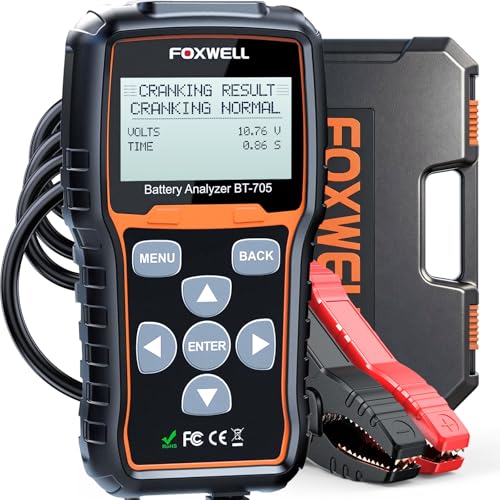
- ✓ Clear guided testing
- ✓ Long reach cable
- ✓ Durable build
- ✕ Size could be bulky
- ✕ Slight learning curve
| Supported Battery Types | Flooded, AGM, GEL, and EFB lead-acid batteries |
| Voltage Coverage | 12V and 24V automotive battery systems |
| Battery Capacity Range (CCA) | 100–2000 CCA |
| Test Cable Length | 5.9 ft |
| Measurement Features | Tests battery health, cranking performance, charging output, internal resistance, and voltage; reports GOOD/RECHARGE/REPLACE |
| Display / User Interface | 2.8-inch LCD display with guided step-by-step prompts |
I wasn’t sure what to expect until the BT705’s 2.8-inch screen lit up and showed a clean “GOOD” vs “RECHARGE/REPLACE” readout. Compared to the handful I’ve used, this one feels like it was built for real garages, not just a showroom.
From the moment you unbox it, you notice the rugged housing and the thick clamps that don’t complain when you clamp onto a stubborn battery. The 5.9-foot test lead is the real trick here, letting you sit at the wheel and watch the screen without a second pair of hands.
You’ll follow guided prompts, which feels genuinely helpful if you’re not a battery nerd. It walks you through checking CCA, voltage, internal resistance, and SOH, with plain-language results.
It’s reassuring to see a single line that clearly tells you GOOD, RECHARGE, or REPLACE.
During a cold-start test at 32°F, the BT705 still spit out a steady cranking voltage readout. It’s not just about the numbers; you can actually see the trend as the engine turns over, which helps you judge if the battery is fading or still up to the task.
The included carrying case and durable clamps make this feel like a tool you’ll actually store and protect. It’s designed for repeat use across multiple vehicles, from daily drivers to fleet workhorses, and that practicality shines in real life.
If you’re solo and need to test while the car is running, you’ll appreciate the one-person testing flow. It’s not the smallest device, but the build quality and the clear results make it worth the slightly larger footprint.
In short, the BT705 blends guided, easy-to-interpret testing with the practicality of a long reach cable and sturdy construction. It’s a smart upgrade from basic testers and clearly aimed at real-world reliability.
MOTOPOWER MP0515A 12V Car Battery Tester (CCA 100–2000)

- ✓ Fast battery health readout
- ✓ Real-time wave display
- ✓ Easy 3″ LCD screen
- ✕ Limited display depth
- ✕ Basic software interface
| Measurement Range | 12V lead-acid batteries, 100–2000 CCA |
| Display | 3-inch color LCD screen, 240 x 320 pixels |
| Battery Testing Parameters | Health status, charging status, internal resistance, test conclusion (mediocre, good, excellent) |
| Test Functions | Battery health, start/charging system test, alternator output during cranking and while engine is running |
| Real-Time Monitoring | Output waveform display with real-time monitoring |
| Languages Supported | 9 languages (English, Spanish, French, German, Italian, Russian, Portuguese, Chinese, Polish) |
You pop the hood on a Friday night, flashlight in one hand, and the MP0515A sits obediently on the workbench like a tiny dashboard assistant. The first thing you notice is that bright 3-inch color LCD, crisp enough to read under the garage glare without squinting.
You plug in a 12V lead-acid battery, press a few quick buttons, and the screen instantly shows a healthy green line and a clear verdict.
What follows feels painless: you see the health status, charging status, and even internal resistance in seconds. It’s not shouting in big letters—just a calm, practical readout you can trust when your gut tells you something’s off with the battery.
The app-esque vibe is nice, but you’re really here for real-world results, and this gives them fast.
The tool handles a range of 12V batteries from 100 to 2000 CCA, so you don’t have to juggle adapters. You can test the starting voltage during cranking and watch the alternator output while the engine runs—exactly the kind of check you want before you blame the battery for a failure to start.
The real-time wave display is a little nerdy, but it’s surprisingly useful if you want to see a signature curve of the battery’s health over a short drive. It isn’t a full oscilloscope, yet it colors in the story behind the numbers.
The device feels sturdy in your hand and the buttons have a reassuring click as you navigate between functions.
For the price, it’s a no-brainer in a home garage. It’s intuitive, portable, and quick enough to become your go-to first check before a jump or a replacement decision.
If you’re sick of guessing, this little tester makes the call with concrete data you can trust.
What is a Battery Cranking Amp Tester and How Does it Work?
A battery cranking amp tester is an essential tool for assessing the starting power of a vehicle’s battery, specifically its ability to deliver sufficient voltage and current under load. This measurement is critical for ensuring a vehicle starts reliably, especially in cold weather conditions.
The cranking amps, or CCA (Cold Cranking Amps), indicate the number of amps a battery can provide at 0°F (-18°C) for 30 seconds while maintaining a minimum voltage of 7.2 volts. A tester evaluates the battery’s performance by applying a simulated load that mimics the conditions during engine start-up.
How It Works:
-
Connection: The tester typically connects to the battery terminals, with positive and negative clamps attached appropriately.
-
Load Application: Once connected, the tester applies a load to the battery, mirroring the demand during cranking.
-
Measurement: It then measures how well the battery maintains voltage and delivers current. The results will provide the CCA rating, enabling users to compare it against the battery’s specifications.
-
Evaluation: If the reading is lower than the manufacturer’s CCA rating, the battery may be weak or nearing the end of its useful life. Regular testing can help identify potential failures before they become problematic.
Why Are Cranking Amps Critical for Battery Performance?
Cranking amps, or Cold Cranking Amps (CCA), are crucial for determining a battery’s ability to start an engine, especially in colder temperatures. The CCA rating indicates how much current a battery can deliver at 0°F (-18°C) for 30 seconds while maintaining a voltage of at least 7.2 volts. This measurement is vital for vehicle performance and reliability.
Understanding cranking amps is essential for several reasons:
- Engine Start Performance: A higher CCA means the battery can start the engine more effectively, particularly in frigid conditions where cold temperatures can sap battery power.
- Battery Lifespan: Regularly using a battery below its CCA rating can strain the battery, leading to faster degradation and reduced lifespan.
- Safety and Reliability: A reliable battery ensures that the vehicle starts consistently, which is critical for safety, especially in emergencies or during adverse weather conditions.
Investing in a battery tester that evaluates CCA helps ensure optimal battery performance, extending its life and ensuring dependable starts when needed.
What Key Features Should a Quality Battery Cranking Amp Tester Include?
The best battery cranking amp tester should include several key features to ensure accurate testing and usability.
- Digital Display: A clear, easy-to-read digital display is essential for showing the results of the cranking amp test. It allows users to quickly assess battery performance without straining to read analog gauges.
- Load Testing Capability: The tester should be able to apply a load to the battery to simulate cranking conditions. This feature helps determine if the battery can provide adequate power when needed, making it crucial for evaluating battery health.
- Built-in Protection Features: Quality testers come with built-in safety mechanisms to prevent short circuits or overloads. These safety features protect both the device and the user, ensuring safe operation during testing.
- Compatibility with Different Battery Types: A versatile tester should work with various battery types, including lead-acid, AGM, and gel batteries. This makes the tool more useful for different applications, whether for cars, motorcycles, or marine use.
- Temperature Compensation: Battery performance can vary with temperature, so having a tester that compensates for ambient temperature ensures more accurate readings. This feature helps users get reliable results under different environmental conditions.
- Ease of Use: The tester should have a straightforward interface with intuitive controls. User-friendly operation ensures that even those with minimal technical knowledge can effectively test their batteries.
- Durability: A quality battery cranking amp tester should be built to withstand regular use and potentially harsh conditions. A rugged design, often with rubberized edges or casings, increases its longevity and reliability.
- Portable Design: A lightweight and compact tester is preferable for ease of transport, especially for mechanics or users who perform tests in various locations. Portability enhances convenience, allowing users to check battery performance wherever needed.
How Do Different Types of Battery Cranking Amp Testers Compare?
| Type | Cranking Amps | Price | Features |
|---|---|---|---|
| Digital Tester | Up to 1200 CCA | $30 – $100 | Easy to read, accurate readings, multiple tests, Brands: NOCO, Schumacher, Weight: 1.5 lbs, Compatibility: Lead-acid, AGM, Warranty: 1 year |
| Analog Tester | Up to 800 CCA | $20 – $70 | Simple design, basic functionality, less accurate, Brands: Sunpro, Actron, Weight: 2 lbs, Compatibility: Lead-acid, Warranty: 90 days |
| Load Tester | Up to 2000 CCA | $50 – $150 | Stress tests battery under load, durable, Brands: ESI, Midtronics, Weight: 5 lbs, Compatibility: Lead-acid, Warranty: 1 year |
| Smart Tester | Up to 1000 CCA | $40 – $120 | Bluetooth connectivity, app integration, detailed analysis, Brands: Ansmann, CTEK, Weight: 1.2 lbs, Compatibility: Lead-acid, AGM, gel, Warranty: 2 years |
How Can You Effectively Use a Battery Cranking Amp Tester?
Using a battery cranking amp tester effectively requires a few key steps to ensure accurate measurements and reliable results. Follow these guidelines:
-
Preparation: Ensure the battery is charged and in good working condition. Disconnect any accessories or devices that may draw power during testing.
-
Check Connections: Connect the tester’s leads to the battery terminals—red for positive (+) and black for negative (–). Ensure tight and corrosion-free connections to get precise readings.
-
Set Parameters: Turn on the tester and select the appropriate mode for testing cranking amps (CA) or cold cranking amps (CCA), depending on your needs.
-
Crank the Engine: If testing a starting battery, crank the engine while observing the tester’s display. Monitor the voltage drop; a significant drop can indicate a weak battery.
-
Analyze Results: Compare the reading to the manufacturer’s specified CCA rating. If the result is lower than expected, consider recharging or replacing the battery.
-
Safety Precautions: Always wear protective gear, ensure there’s good ventilation, and follow the manufacturer’s instructions for both the tester and the battery.
These steps will help accurately assess the health of your battery and determine whether it needs maintenance or replacement.
What Are the Top Recommendations for Battery Cranking Amp Testers on the Market?
The top recommendations for battery cranking amp testers on the market are:
- Suner Power BT-100: This portable and lightweight tester allows users to measure the cranking amps of a battery easily and accurately.
- Schumacher BT-100: Known for its durable design, this tester provides precise readings and includes a built-in display for easy monitoring.
- Chiciris Car Battery Tester: This compact tester stands out for its user-friendly interface and the ability to test both 12V and 24V batteries efficiently.
- Midtronics MDX-650P: A professional-grade tester that offers advanced diagnostics and is ideal for both personal and commercial use.
- Foxwell BT-705: This versatile tester features multiple testing modes and can also diagnose other battery-related issues, making it a comprehensive tool.
Suner Power BT-100: This portable and lightweight tester allows users to measure the cranking amps of a battery easily and accurately. It features an easy-to-read LCD display that shows results quickly and has a built-in safety feature to prevent reverse polarity during use.
Schumacher BT-100: Known for its durable design, this tester provides precise readings and includes a built-in display for easy monitoring. Its robust construction is suitable for both home mechanics and professionals, ensuring reliable testing over time.
Chiciris Car Battery Tester: This compact tester stands out for its user-friendly interface and the ability to test both 12V and 24V batteries efficiently. It is designed with clear instructions and visual indicators, making it accessible for beginners while still offering accurate results for seasoned users.
Midtronics MDX-650P: A professional-grade tester that offers advanced diagnostics and is ideal for both personal and commercial use. This device provides comprehensive information about battery health and performance, ensuring that users can make informed decisions about battery maintenance or replacement.
Foxwell BT-705: This versatile tester features multiple testing modes and can also diagnose other battery-related issues, making it a comprehensive tool. Its advanced technology allows for quick assessments and detailed insights, catering to users who require thorough analysis beyond just cranking amps.
How Do User Reviews Influence Your Choice of Battery Cranking Amp Tester?
User reviews significantly influence the choice of a battery cranking amp tester by providing insights into performance, reliability, and user experience.
- Performance Feedback: User reviews often highlight how effectively a tester measures cranking amps, which is crucial for assessing battery health. Many users share their experiences with different brands and models, discussing if the tester accurately reflects the actual cranking amps under various conditions.
- Durability Insights: Reviews can reveal how well a tester holds up over time, which is an important consideration for those who use it frequently. Feedback regarding the build quality and longevity of the device helps potential buyers understand whether it’s worth the investment.
- Ease of Use: Users frequently comment on the user-friendliness of a battery cranking amp tester. This includes aspects like the readability of the display, the intuitiveness of the controls, and the overall setup process, which can greatly affect the user’s experience.
- Customer Support Experiences: Reviews often include information about the manufacturer’s customer service and warranty policies. Positive experiences can reassure buyers of reliable support if they encounter any issues with their tester, while negative feedback might deter potential customers.
- Value for Money: Many reviews touch on whether users feel that the tester provides good value relative to its price. This can help prospective buyers compare different models and make informed decisions based on features and performance versus cost.