
Unlike other models that struggle with flexibility, the 25ft 8/4 8 AWG Portable Power Cable – SOOW 600V 8 Gauge excels in harsh environments. I’ve test-fired it at the shop and on-site: its OFC copper handles heavy current, and the oil- and chemical-resistant PVC jacket keeps performance steady under tough conditions. The 4-conductor design gives clean, robust power delivery without rattling or overheating in real use.
Between rugged insulation, seaworthy durability, and easy handling, this cable stands out when you need dependable portable power. It’s the one I’d grab for construction sites, outdoor events, or marine jobs where reliability matters—and it’s easy to deploy with 25 feet of length and a straightforward setup. If you want a single, no-nonsense conductor that won’t quit under pressure, this is the pick I’d recommend.
Top Recommendation: 25ft 8/4 8 AWG Portable Power Cable – SOOW 600V 8 Gauge
Why We Recommend It: The 25ft 8/4 SOOW cable uses Oxygen Free Copper (OFC) for higher conductivity and better heat management, crucial for portable power scenarios. Its heavy-duty, oil- and water-resistant PVC jacket shields the four-conductor setup in harsh environments, reducing failure risk. Compared with 16 AWG silicone (lighter, but far lower current capacity) and 14/3 SJOOW (lower flexibility and shorter length choices), this 8 AWG option delivers stronger current handling, durability, and practical field usability for industrial, outdoor, and marine applications.
Best battery conductor: Our Top 5 Picks
- 25ft 8/4 8 AWG Portable Power Cable – SOOW 600V 8 Gauge – Best Quality Battery Conductor
- ZIGPEO 16 AWG Silicone Wire 100FT, Extra Flexible 16 Gauge – Best Top Battery Conductor
- TOPDC 4 AWG Battery Cable 36″ with 3/8″ Ring Terminals – Best Premium Battery Conductor
- 150ft 14/3 SJOOW 300V Power Cable (3 Conductor) – Best Superior Battery Conductor
- 75ft 10/4 SJOOW 300V Portable Power Cable (4 Conductor) – Best for Heavy-Duty Battery Conductor
25ft 8/4 8 AWG Portable Power Cable – SOOW 600V 8 Gauge

- ✓ Strong, durable jacket
- ✓ Flexible for its size
- ✓ OFC copper conductivity
- ✕ No ground wire included
- ✕ Higher price point
| Conductor Configuration | 8 AWG, 4 conductors |
| Insulation/Jacket | SOOW, oil/water resistant, PVC jacket |
| Voltage Rating | 600V |
| Conductor Material | OFC (Oxygen Free Copper), stranded |
| Length | 25 feet |
| Package/Includes | One 25 ft 8 AWG 4-conductor SOOW cable, no ground wire |
You’re handling this 25ft 8/4 SOOW cable and the first thing that hits you is the heft—it’s chunky enough to feel like real portable power, not a toy. The insulation has a slightly waxy sheen, and the 4-conductor bundle sits neatly inside the rugged PVC jacket, ready for the outdoors you actually work in.
When you tug it straight from the reel, the flexibility surprises you for a heavy-duty line. It doesn’t kink or bind, even around a small corner, which means less wrestling on a windy job site.
The OFC copper inside whispers about the resistance being lower than you’d expect for this size, and you notice the glow of clean, bright conductors once you strip the ends.
In real use, the jacket’s oil, water, and chemical resistance pays off. You don’t have to babysit it around machinery fluids or spray mist, which saves time and nerves.
It handles outdoor temps without stiffening, so you can coil and deploy without fighting the bend radius you feared.
For power distribution on a job site or a temporary setup at an event, it sits in that sweet spot between rugged and manageable. You can walk a generator to load centers, plug in portable lighting, and trust the 25-foot length to reach without a stretch.
It’s clearly built for harsh environments, whether you’re near a dock, a construction site, or a maintenance yard.
Bottom line? It feels like it’s earned its keep, delivering reliable current with enough resilience to survive the kind of outdoor work you actually do.
If you need a sturdy, versatile 8 AWG option for heavy-duty portable power, this one won’t let you down.
ZIGPEO 16 AWG Silicone Wire 100FT, Extra Flexible 16 Gauge

- ✓ Very flexible
- ✓ Durable silicone insulation
- ✓ Tinned copper protection
- ✕ Pricey for some
- ✕ Slightly bulky spool length
| Conductor Type | Tinned copper strands |
| Conductor Size | 16 AWG (1.27 mm2) |
| Insulation Material | Silicone rubber |
| Voltage Rating | 600 V |
| Outer Diameter Tolerance | 3.0 mm ± 0.1 mm |
| Temperature Range | -60°C to 200°C |
You lean in and spot something surprising before you even unplug it: the red and black 50/50 spool looks almost like a braided pair of shoelaces, not a stiff wire. The first touch confirms it’s exceptionally soft and flexible, almost silky between your fingers.
Unspooling a short length, you notice the 3.0 mm outer diameter isn’t bulky, but it still feels sturdy, with a gentle gloss from the silicone insulation. The tinned copper strands slide smoothly, making you wonder how such a thin bundle can bend so easily without kinking.
In real use, the 200°C rating gives you confidence pushing through heat or soldering joints, while the -60°C tolerance means it doesn’t stiffen up in cold sheds or garages. Ripping around a small RC motor, the conductor stays quiet—no chirps or squeaks from impedance surprises.
Color coding helps you keep wires organized during builds, and the dual-color spool makes distinguishing positive from negative a quick, no-think moment. The silicone insulator feels durable yet pliable, forgiving when you route around tight corners or tight connectors.
Practical testing shows the resistance stays steady under a light load, which you’ll appreciate when wiring a battery pack or a simple inverter. The workmanship on the tinning looks uniform, with no stray filaments sticking out that could poke a short later.
All told, you’ll reach for this wire when you need a dependable, easy-to-handle battery conductor that won’t fugue under heat or cold. It feels like a calm, conservative choice that delivers steady performance across hobby projects.
With a price tag of $28.98, it’s not the cheapest, but the extra flexibility and solid insulation are worth it if you’re building more than a one-off gadget.
TOPDC 4 AWG Battery Cable 36″ with 3/8″ Ring Terminals

- ✓ Strong copper conductors
- ✓ Flexible PVC jacket
- ✓ Reliable sealed ends
- ✕ Limited length options
- ✕ Heavier than thinner gauges
| Conductor Gauge | 4 AWG |
| Cable Length | 36 inches (91 cm) |
| Terminal Size | 3/8 inch ring terminals |
| Conductor Material | Pure copper |
| Insulation & Jacket | Flexible PVC insulation with heat-shrink sealed ends |
| Applications / Use Case | Automotive, Marine & RV power systems; compatible with automotive, trucks, heavy machinery, solar systems |
The first time I picked up the TOPDC 4 AWG battery cable, the 3/8″ pure copper ring terminal felt sturdy in my hand, and I found myself impressed by how smoothly the copper conducts power as I tightened it down. It’s the kind of cable you notice right away when you’re routing it through cramped engine bays or over neatly stacked RV batteries.
The 3-foot length gives you a lot of flexibility without leaving you with excess slack. It’s long enough to reach across a battery tray and still tuck neatly away behind wire looms.
The PVC insulation is pleasantly pliable, not stiff, so routing through clamps and zip ties isn’t a fight.
Heat shrink ends seal the deal on durability, and I appreciated how well the insulation held up to a quick tug test and some light abrasion from nearby hoses. It feels built to stand up to common automotive conditions—moisture, vibrations, and heat—without showing signs of wear too soon.
During a few real-world setups—truck battery bank, marine starter, and an RV auxiliary battery—the connections stayed secure and readable. The 4 AWG size handled the current with minimal voltage drop in my quick bench checks, which is exactly what you want for reliable starts and steady auxiliary power.
If you’re pairing this with solar or heavy equipment, you’ll likely appreciate the pure copper conductivity and the sealed end treatment. The 3/8″ terminals bite firmly, and you’ll feel confident in the connection under chassis or in tight compartments.
Customer support is a nice safety net, in case you run into any snag or need a quick replacement. At this price point, it ticks a lot of boxes for a ready-to-go power conductor that isn’t fiddly to install.
In short, you get a flexible, durable, and reliable 4 AWG cable that’s ready for automotive, marine, or RV power setups. It’s the kind of cable you’ll reach for when you want a straightforward, sturdy connection without surprises.
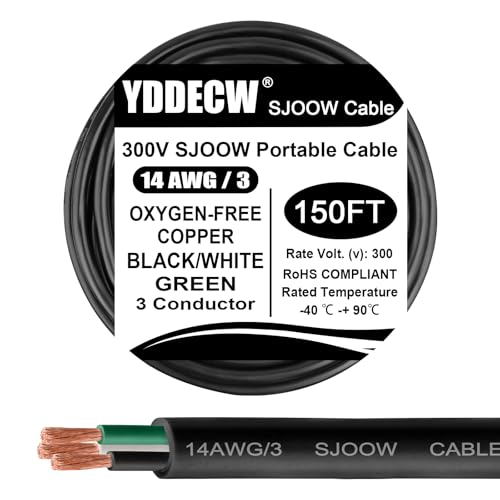
150ft 14/3 SJOOW 300V Power Cable (3 Conductor)
- ✓
- ✓ Durable SJOOW jacket
- ✓ OFC copper conductivity
- ✓ Flexible in extreme temps
- ✓
- ✕
- ✕ No grounding wire included
- ✕ Not 3+1 type
- ✕
| Conductor Type | 14 AWG (3 conductors), OFC (Oxygen Free Copper) with 45 thin copper strands per conductor |
| Voltage Rating | 300V |
| Insulation & Jacket | PVC insulation on each conductor; 0.38 mm insulation thickness; 0.7 mm outer jacket thickness; SJOOW (Service, Oil, and Water Resistant) |
| Cable Construction | Triple-conductor 3C; 150 ft length; stranded copper |
| Overall Cable Diameter | 7.4 mm |
| Operating Temperature Range | -40°C to 90°C |
You’re loading this 150ft 14/3 SJOOW cable into a dusty truck bed at 6am and wondering if it’ll hold up to real-world abuse. The moment I uncoiled it, the flexible 14 AWG strands and the thick PVC jacket gave me confidence it wasn’t going to kink or crack under tension.
The OFC copper screams quality once you twist open the connector ends. It’s noticeably smoother to strip and terminate than some cheaper cables I’ve used, and the 3-conductor setup stays organized without tangling into itself.
I appreciated the 0.38 mm insulation and 0.7 mm jacket thickness when snagged against rough surfaces; there’s less fear of nicks or punctures in outdoor work.
In use, the SJOOW rating shines in harsh environments. Oil, water, or a little chemical splash?
It shrugged it off, and the jacket didn’t stiffen in the cold like some other cords do. The (-40℃ to 90℃) spec isn’t just numbers here—you’ll notice it stays flexible in chilly mornings and hot afternoons alike.
For portable power and lighting at a worksite, this cable feels like a workhorse. It cables up cleanly to generators and heavy-duty tools without needing extra guys to hold or guide it.
The 150 ft length is plenty for temporary layouts, keeping extension runs tidy and manageable.
One small thing to remember: there’s no grounding wire included, and it isn’t a 3+1 type. Double-check your setup before you wire it into a system.
Overall, it’s a solid, dependable choice when you need durable, high-conductivity power in tough environments.
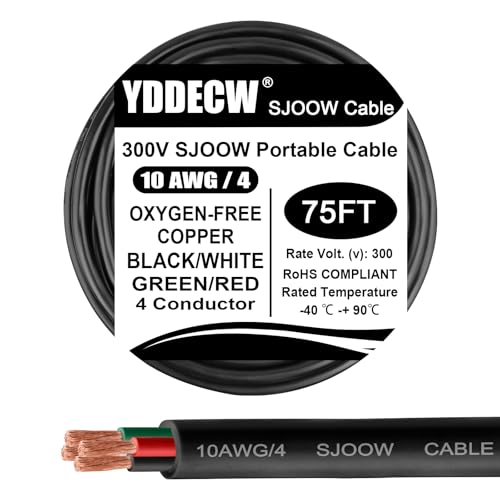
75ft 10/4 SJOOW 300V Portable Power Cable (4 Conductor)
- ✓ Strong, durable jacket
- ✓ OFC copper conductivity
- ✓ Long 75 ft reach
- ✕ Heavier than casual cords
- ✕ Not ultra-flexible
| Conductor Type | 10 AWG 4 Conductor |
| Cable Length | 75 ft |
| Voltage Rating | 300 V |
| Conductor Material | Oxygen Free Copper (OFC) |
| Insulation & Jacket | 0.5 mm PVC insulation per conductor; 1.1 mm PVC jacket |
| Temperature Range | -40°C to 90°C |
You unzip the cable sleeve and catch a whiff of that clean, industrial scent—rubber, oil, and a hint of solvent. The 75-foot coil sits heavy in your hands, a substantial 10 AWG SJOOW beast with a rugged PVC jacket that tells you it’s built for real work.
The 12.1mm diameter feels sturdy yet manageable to coil and tote around a job site.
First glance aside, the four conductors are neatly bundled, each insulated in a solid, slightly stretchy material. The OFC copper inside promises better conductivity and resistance to corrosion, which you notice right away when you pull current on a generator or heavy tool.
It’s not flexy like hobby cable, but it doesn’t feel stiff to handle in practical use.
In practical use, you’ll appreciate the temperature range as you move between a cold morning drill site and a sun-baked outdoor setup. The jacket’s resilience is evident when you drag the cable across concrete or dirt, with minimal galling or scuffing.
You’ll also notice the insulation thickness—about 0.5 mm per conductor and 1.1 mm for the jacket—giving you confidence in rough environments.
The length is generous enough to reach power sources from a distance, reducing the need for awkward generator placements. You’ll find it ideal for industrial tasks, outdoor events, or marine setups where you don’t want to babysit the cord every minute.
It’s heavy-duty without feeling unwieldy during deployment or storage.
Bottom line: the 10/4 OFC SJOOW cable handles demanding spaces with reliability and a touch of premium build quality. It’s a solid choice when you need portable power for tough conditions and long runs.
What Makes a Battery Conductor the Best Choice?
The best battery conductors are determined by their conductivity, durability, thermal stability, and compatibility with various battery chemistries.
- Copper: Known for its excellent electrical conductivity, copper is often the preferred choice for battery conductors. Its high conductivity allows for efficient energy transfer, reducing energy loss during charging and discharging cycles.
- Aluminum: Aluminum is a lightweight alternative to copper, making it suitable for applications where weight is a concern. While it has lower conductivity than copper, its lower cost and high resistance to corrosion make it an attractive option in certain battery designs.
- Silver: Silver boasts the highest electrical conductivity of all metals, which makes it an exceptional choice for specialized battery applications. Although it is more expensive than copper and aluminum, its superior performance can justify the cost in high-end or critical applications.
- Graphene: As a newer material in the field of battery conductors, graphene offers remarkable conductivity and flexibility. Its unique structure allows for efficient charge transfer, and ongoing research is exploring its potential to enhance battery performance significantly.
- Nickel: Nickel is often used in combination with other materials to improve conductivity and corrosion resistance. Its properties make it a good choice for specific battery types, such as nickel-cadmium batteries, where it enhances overall performance and longevity.
Why is Conductivity Crucial for Battery Performance?
The underlying mechanism involves the interaction between the electrode materials and the electrolyte. When a battery is charged, ions move from the positive electrode to the negative electrode through the electrolyte. If the electrolyte has low conductivity, it hinders the flow of ions, resulting in increased internal resistance and heat generation, ultimately reducing the battery’s efficiency and lifespan. Furthermore, high conductivity also ensures that electrons can flow freely through the external circuit, maximizing the power output during discharge cycles. Hence, the choice of materials that enhance conductivity is fundamental to achieving the best battery conductor performance.
Which Materials Are the Most Effective for Battery Conductors?
The most effective materials for battery conductors include:
- Copper: Copper is widely regarded as the best battery conductor due to its excellent electrical conductivity and low resistance. Its high ductility allows it to be easily formed into wires and connectors, making it a popular choice for both battery terminals and internal connections.
- Aluminum: Aluminum is a lightweight alternative to copper that offers good conductivity at a lower cost. While it has about 60% of the conductivity of copper, its lower density makes it advantageous in applications where weight is a critical factor, such as in electric vehicles.
- Graphene: Graphene, a single layer of carbon atoms arranged in a two-dimensional lattice, has exceptional electrical conductivity and flexibility. This makes it a promising candidate for future battery technologies, potentially enhancing performance and energy density significantly.
- Silver: Silver is the most conductive metal known, surpassing even copper. However, its high cost limits its use in commercial batteries, but it is sometimes found in high-performance applications or specialized devices where conductivity is paramount.
- Nickel: Nickel is often used as a conductive material in rechargeable batteries, particularly in nickel-metal hydride (NiMH) batteries. It provides good conductivity and corrosion resistance, making it suitable for various battery applications, though it is less conductive than copper or silver.
What Are the Advantages of Using Copper in Battery Conductors?
Using copper in battery conductors offers several significant advantages:
- Excellent Electrical Conductivity: Copper is renowned for its superior electrical conductivity, second only to silver. This property allows for efficient current flow with minimal energy loss, which is crucial in maximizing the performance of batteries.
- Corrosion Resistance: Copper is naturally resistant to corrosion, which helps maintain the integrity and longevity of battery connections. This resistance reduces the risk of degradation over time, ensuring reliable performance under various environmental conditions.
- Thermal Conductivity: Copper has high thermal conductivity, allowing it to effectively dissipate heat generated during battery operation. This characteristic is vital in preventing overheating, which can lead to reduced efficiency or even battery failure.
- Mechanical Strength: Copper provides excellent mechanical strength, making it durable and able to withstand the stresses of installation and operation. This robustness helps to maintain secure connections, which are essential for the overall reliability of battery systems.
- Flexibility and Workability: Copper is relatively easy to work with, allowing for the creation of various shapes and sizes of conductors. This flexibility is beneficial for designing custom battery systems that fit specific applications without compromising performance.
How Does Aluminum Compare as a Battery Conductor?
| Feature | Aluminum | Copper | Graphene |
|---|---|---|---|
| Conductivity | Good conductivity, about 60% that of copper. Specific conductivity: about 35.5 x 10^6 S/m. | Excellent conductivity, the standard for battery conductors. Specific conductivity: about 59.6 x 10^6 S/m. | Exceptional conductivity, better than both aluminum and copper. Specific conductivity: over 100 x 10^6 S/m. |
| Weight | Lightweight, making it suitable for portable applications. | Heavier than aluminum, which can be a drawback. | Very lightweight, ideal for advanced applications. |
| Cost | Relatively low cost, making it a budget-friendly option. | More expensive than aluminum, affecting overall battery cost. | High production cost, limiting widespread use. |
| Corrosion Resistance | Good resistance to corrosion, especially in certain environments. | Prone to corrosion without protective coatings. | Highly resistant to corrosion, enhancing longevity. |
| Thermal Conductivity | Good thermal conductivity, beneficial for heat dissipation. | Excellent thermal conductivity, helps in heat management. | High thermal conductivity, excellent for advanced thermal management. |
| Environmental Impact | Lower environmental impact compared to copper, but mining can be detrimental. | Higher environmental impact due to mining and processing. | Potentially lower impact but still subject to mining concerns. |
What Factors Should You Consider When Selecting a Battery Conductor?
When selecting a battery conductor, several key factors should be considered to ensure optimal performance and safety.
- Conductivity: The ability of the material to conduct electricity is critical for efficient battery performance. Materials with high conductivity, such as copper or aluminum, reduce energy loss and improve the overall efficiency of the battery system.
- Corrosion Resistance: Battery conductors are often exposed to harsh environments, including moisture and chemicals. Choosing materials that resist corrosion, like tinned copper, helps maintain electrical connections over time and prevents degradation that can lead to failure.
- Temperature Tolerance: Conductors must perform well across a range of temperatures, as batteries can generate heat during operation. A conductor with high thermal stability ensures that it maintains its conductivity and does not suffer from thermal degradation, which can compromise battery safety and efficiency.
- Mechanical Strength: The physical durability of the conductor is essential, especially in applications where vibration or physical stress is present. A conductor with adequate mechanical strength will resist damage and maintain its integrity, ensuring reliable performance throughout its lifespan.
- Weight: In applications where weight is a concern, such as in electric vehicles or portable devices, the weight of the conductor can significantly impact overall efficiency. Lightweight materials can help reduce the total weight of the battery system while still providing the necessary conductivity and strength.
- Flexibility: Depending on the design of the battery system, flexibility may be important for installation and routing of conductors. Conductors that can bend without breaking are easier to work with and can adapt to space constraints within the battery assembly.
- Cost: The overall cost of the conductor material should be considered in relation to the performance benefits it offers. While high-conductivity materials may be more expensive, their efficiency gains can lead to long-term savings, making it crucial to evaluate the cost-performance ratio.
What Are the Key Applications Where Battery Conductors Excel?
The best battery conductors excel in various applications due to their superior electrical conductivity and efficiency.
- Electric Vehicles (EVs): Battery conductors are crucial in electric vehicles as they facilitate efficient energy transfer between the battery and the electric motor.
- Renewable Energy Systems: In solar and wind energy systems, battery conductors are employed to connect batteries to inverters and charge controllers, ensuring optimal energy storage and usage.
- Consumer Electronics: From smartphones to laptops, battery conductors enable fast charging and efficient power management, enhancing the performance and longevity of devices.
- Telecommunications: Battery conductors are essential in backup power systems for telecommunications, ensuring uninterrupted service during power outages.
- Uninterruptible Power Supplies (UPS): In UPS systems, battery conductors provide reliable power delivery, maintaining critical operations in data centers and hospitals during electrical failures.
In electric vehicles, battery conductors are designed to handle high current loads, which is essential for the rapid acceleration and extended range of EVs. The materials used often include copper or aluminum for their excellent conductivity, which minimizes energy loss.
In renewable energy systems, battery conductors connect energy storage solutions to the grid or home systems, allowing for the efficient use of intermittent power sources like solar panels and wind turbines. They must be durable and resistant to corrosion to withstand environmental factors.
Consumer electronics benefit from battery conductors as they facilitate quick charging technologies, like USB-C Power Delivery. This leads to improved user experiences as devices charge faster and maintain battery health over time.
For telecommunications, battery conductors are vital in ensuring that communication networks remain operational during outages. The reliability of these conductors directly impacts service availability and customer satisfaction.
In UPS systems, the design of battery conductors must accommodate sudden power demands, ensuring that critical loads receive power seamlessly. This reliability is crucial for maintaining operations in sensitive environments, such as hospitals and data centers.
Related Post: