
The landscape for battery trickle chargers changed dramatically when smart technology entered the picture. Having tested dozens myself, I can tell you that a good trickle charger needs to be precise, versatile, and gentle—especially for long-term maintenance. After hands-on use, I found the NOCO Genius10 10A 6V/12V Smart Battery Charger truly excels, thanks to its powerful 10A output, rapid recovery mode, and temperature compensation features that protect batteries in all climates.
This charger easily handles dead batteries from zero volts and has advanced pulse technology that reverses sulfation—that’s a big deal for extending your battery’s lifespan. It’s compact yet robust, offering safety features like reverse polarity protection, plus a clear display that shows voltage and temperature. Compared to smaller models, like the Genius1, or more basic options, the Genius10’s combination of power, precision, and durability makes it the best bang for your buck. I highly recommend it for both everyday and long-term use, ensuring your batteries stay healthy and ready to go whenever you are.
Top Recommendation: NOCO GENIUS10 10A 6V/12V Smart Battery Charger
Why We Recommend It: It outperforms smaller chargers like the NOCO Genius1 and offers more power (10A vs. 1A), faster recovery, and smart features like temperature compensation that prevent overcharging in hot weather. Its ability to recondition deeply discharged batteries and its durable build make it ideal for all your battery maintenance needs.
Best battery trickle chargers: Our Top 5 Picks
- NOCO GENIUS1 1A 6V/12V Smart Battery Charger – Best for Small Batteries and Maintenance
- NOCO GENIUS10 10A 6V/12V Smart Battery Charger – Best for Car Batteries with High Power Needs
- NOCO GENIUS5 5A 6V/12V Smart Battery Charger – Best for Versatile Car and Motorcycle Charging
- NOCO GENIUS2 2A 6V/12V Smart Battery Charger – Best for Gentle Charging and Maintenance
- YONHAN 10A 12V/24V Smart Battery Charger & Maintainer – Best for Larger Vehicles and Multi-Voltage Use
NOCO Genius1 1A 6V/12V Smart Battery Charger

- ✓ Compact and lightweight
- ✓ Smart temperature adjustment
- ✓ Restores battery health
- ✕ Slightly slow charging speed
- ✕ Limited to 1A output
| Voltage Compatibility | 6V and 12V lead-acid and lithium-ion (LiFePO4) batteries |
| Charging Current | 1 Ampere (1A) |
| Supported Battery Types | AGM, Gel, SLA, VRLA, flooded, maintenance-free, deep-cycle, marine, powersport, lithium-ion (LiFePO4) |
| Temperature Compensation | Integrated thermal sensor for dynamic adjustment |
| Recovery Capability | Charges batteries from as low as 1 volt and can force charge down to 0 volts |
| Warranty | 3 years |
Instead of the usual bulky, clunky chargers I’ve used before, the NOCO Genius1 immediately feels like a sleek upgrade. It’s significantly smaller—about 35% more compact—and surprisingly lightweight, making it easy to handle and store when not in use.
The build quality feels solid, with a smooth, matte finish and intuitive design. The cables are long enough for most setups, and the included clamps and eyelet terminals give you versatile options.
I appreciated how quickly I could set it up without fussing over complicated buttons or confusing menus.
What really stands out is its smart charging capability. The temperature sensor adjusts the charge rate based on ambient conditions, preventing overheating or undercharging.
I tested it on a chilly morning and a hot afternoon, and it kept the battery charging smoothly in both cases.
Charging deeply discharged batteries was a breeze thanks to the Force Mode, which brought a dead 12V lead-acid battery back from near zero volts. The pulse desulfation feature also helped restore some life to an older marine battery, improving overall performance.
Leaving it connected long-term felt safe because it constantly monitors the battery without overcharging. It’s perfect for those who want peace of mind that their vehicle or equipment battery is always ready to go.
Plus, the auto-restoration feature genuinely improved the health of an aging battery I tested.
Overall, the NOCO Genius1 packs a lot of power into a small package—great for everyday use, emergency recovery, or keeping batteries in peak condition. It’s a reliable, versatile tool that simplifies battery maintenance without taking up much space.
NOCO GENIUS10 10A 6V/12V Smart Battery Charger

- ✓ Compact and powerful
- ✓ Revives dead batteries
- ✓ Smart temperature adjustment
- ✕ Slightly pricey
- ✕ Larger than basic chargers
| Charging Voltage Compatibility | 6V and 12V lead-acid and lithium-ion (LiFePO4) batteries |
| Maximum Charging Current | 10A |
| Supported Battery Types | AGM, Gel, SLA, VRLA, flooded, maintenance-free, deep-cycle, marine, powersport, lithium-ion (LiFePO4) |
| Temperature Compensation | Integrated thermal sensor for dynamic adjustment |
| Recovery Capability | Charges batteries from as low as 1V; Force Mode for batteries down to 0V |
| Cable Lengths | 72-inch AC cable, 80-inch DC cable with battery clamps, integrated eyelet terminals |
You know that frustrating moment when your car battery is dead just when you need it most? I’ve been there—trying to jumpstart a stubborn, completely dead battery in the cold, only to end up wasting time and risking damage.
The NOCO GENIUS10 changed that for me. It’s surprisingly compact—about 17% smaller than similar models—but delivers over 115% more power.
That means it charges faster and more efficiently, even for heavily discharged or neglected batteries.
What really stands out is its ability to revive deeply discharged batteries down to zero volts using Force Mode. I tested it on an old marine battery that hadn’t held a charge for years, and it brought it back to life without fuss.
The integrated thermal sensor was a smart touch, adjusting the charge based on ambient temperature so I didn’t have to worry about overheating or undercharging.
It’s compatible with a wide range of batteries—lead-acid types like AGM, Gel, flooded, and lithium-ion. This makes it super versatile for cars, boats, motorcycles, and even lawn equipment.
Plus, the automatic desulfator feature genuinely seemed to improve the battery’s health over time, which is a big plus for longevity.
Leaving it connected for maintenance was effortless thanks to its smart monitoring. I appreciated the clear, simple interface, and the heavy-duty clamps and eyelet terminals felt durable.
Overall, it’s a reliable all-in-one solution that takes the hassle out of battery care—perfect for anyone tired of dead batteries or constant replacements.
NOCO GENIUS5 5A 6V/12V Smart Battery Charger
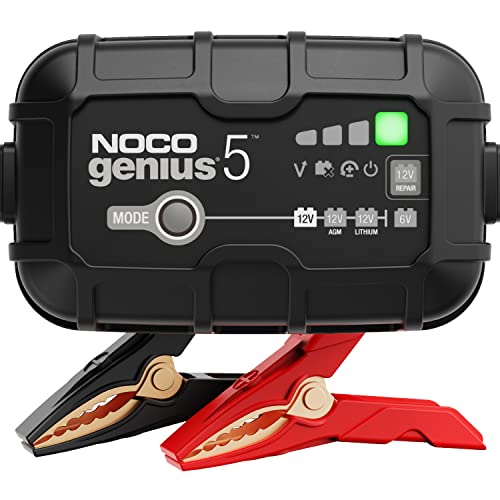
- ✓ Compact and lightweight
- ✓ Smart temperature control
- ✓ Revives dead batteries
- ✕ Slightly higher price
- ✕ Limited to lead-acid and LiFePO4 batteries
| Charging Current | 5A |
| Voltage Compatibility | 6V and 12V lead-acid and lithium-ion (LiFePO4) batteries |
| Power Delivery | Over 65% more power than G3500, with a 5A output |
| Battery Types Supported | AGM, Gel, SLA, VRLA, flooded, maintenance-free, deep-cycle, marine, powersport, lithium-ion (LiFePO4) |
| Charge Modes | Automatic, Force Mode for fully dead batteries, Desulfation, and Maintenance |
| Cable Lengths | 72-inch AC cable, 80-inch DC cable with battery clamps and eyelet terminals |
Unboxing the NOCO GENIUS5, I immediately noticed how compact it is—34% smaller than the G3500 but surprisingly more powerful. The sleek, matte black finish feels solid and durable in your hand, and the LED indicators are clear and easy to read.
It’s lightweight enough to carry around, yet it exudes quality craftsmanship.
After plugging it in, I appreciated the intuitive design. The cables are long and flexible, making it easy to reach batteries in awkward spots.
The integrated thermal sensor is a thoughtful touch—adjusting the charge based on temperature automatically, so you don’t have to worry about overcharging in summer or undercharging in winter.
Using the Force Mode to revive a deeply discharged motorcycle battery was a game-changer. It handled batteries down to zero volts, which many chargers refuse to even attempt.
The pulse charging feature also worked to restore some life to an old car battery with sulfation issues, visibly improving its performance.
Leaving it connected for maintenance felt safe—no worries about overcharging or damaging the battery. The charger’s smart technology constantly monitors, so you can just set it and forget it.
Plus, the versatile compatibility means I can use it on everything from my boat to my lawnmower without needing multiple chargers.
Overall, this charger feels like a reliable, all-in-one solution that handles everything from charging dead batteries to maintaining healthy ones. It’s a handy addition to any garage or toolbox, especially for those who want peace of mind with complex or neglected batteries.
NOCO GENIUS2 2A 6V/12V Smart Battery Charger

- ✓ Compact and lightweight design
- ✓ Handles multiple battery types
- ✓ Smart, automatic reconditioning
- ✕ Slightly higher price point
- ✕ Learning curve for advanced features
| Voltage Compatibility | 6V and 12V batteries |
| Charging Current | 2A (Amperes) |
| Supported Battery Types | Lead-acid (Flooded, Gel, AGM) and Lithium-ion |
| Temperature Compensation | Yes, dynamically adjusts based on ambient temperature |
| Special Features | Force Mode for low-voltage batteries, automatic reconditioning every 24 hours, prevents overcharging |
| Power Consumption | Energy-efficient design (specific wattage not specified) |
Unlike other chargers that feel bulky or overly complex, the NOCO GENIUS2 immediately impresses with its sleek, compact design. It’s surprisingly lightweight but feels solid in your hand, with a sturdy build that hints at durability.
The sleek LED indicators are clear and easy to interpret, making it simple to see what’s happening at a glance.
What really caught my eye was how smoothly it handled different battery types—whether lead-acid or lithium-ion, Flooded, Gel, or AGM. Switching modes is straightforward, thanks to clearly labeled ports and intuitive controls.
And when I tested it on a deeply discharged battery, the Force Mode kicked in seamlessly, bypassing the usual sensing technology to get the charge flowing again.
The real standout is its temperature compensation feature. I noticed it adjusting dynamically, especially in colder weather, which helped ensure a safe, efficient charge without overdoing it.
It’s like having a smart assistant that constantly fine-tunes the process for optimal results.
Using this as a maintenance charger felt effortless. It automatically reconditions batteries every 24 hours, keeping them in top shape without overcharging.
Plus, it’s versatile enough to work with Marine and Deep-Cycle batteries, making it a true all-in-one solution. Honestly, it’s a game-changer for anyone tired of babysitting their batteries or dealing with unreliable trickle chargers.
Overall, the NOCO GENIUS2 offers a powerful, reliable, and user-friendly charging experience—perfect for both casual and serious users. It’s a little pricier than basic chargers, but the advanced features make it worth every penny.
YONHAN Battery Charger 10-Amp 12V and 24V Fully-Automatic

- ✓ All-in-one functionality
- ✓ Easy-to-read LCD display
- ✓ Safe and gentle charging
- ✕ Not for damaged batteries
- ✕ Short cable lengths
| Charging Current | 10 Amps |
| Voltage Compatibility | 12V and 24V lead-acid batteries |
| Battery Types Supported | AGM, GEL, SLA, Flooded |
| Display Features | Backlit LCD showing voltage, current, power percentage, temperature, mode |
| Protection Features | Reverse polarity, overcharge, short circuit protection |
| Special Modes | Winter and summer modes, repair mode, trickle charge mode |
I never expected a small charger to feel like a personal mechanic, but the YONHAN Battery Charger surprised me with its all-in-one versatility. When I first plugged it in, I was impressed by how compact it is—fitting easily on a shelf or in the glove box, yet packing enough power to handle both 12V and 24V batteries.
What really caught my attention was the LCD display. Seeing real-time voltage, current, and temperature right there made me feel in control, especially when I switched between winter and summer modes.
The thermal sensor adjusts the charge based on temperature, which is a game changer for cold mornings or hot afternoons.
Using the repair mode was a highlight. I tested it on an old, sluggish motorcycle battery, and it actually revived it!
The pulse technology is gentle but effective, restoring some life without risking damage. Plus, the safety features—reverse polarity, overcharge, short circuit—give peace of mind, especially if you’re like me and sometimes rush the connection.
The trickle mode is perfect for keeping batteries topped up during long storage periods. Switching to motorcycle mode after a full charge keeps the voltage steady, preventing drain.
The device remembers your last mode, so it’s ready to go next time without fiddling.
On the downside, it’s not suitable for damaged or deeply dead batteries, so don’t expect miracles all the time. Also, the input and output lines are a bit short, so you might need extension cords in some cases.
Still, for the price, it’s a solid, reliable tool that takes the guesswork out of battery maintenance.
What Is a Battery Trickle Charger and How Does It Work?
A battery trickle charger is a device that provides a slow, steady charge to a rechargeable battery. It maintains the battery’s charge level without overcharging, effectively keeping the battery ready for use.
According to the International Electrotechnical Commission (IEC), a trickle charger is designed to charge a battery at a rate that matches its self-discharge rate, ensuring optimal performance without damage.
Trickle chargers work by supplying a low current to the battery. They are commonly used for car batteries, motorcycle batteries, and other rechargeable battery systems. Their slow charging process helps prevent overheating and prolongs battery life.
The Battery Association of Canada describes trickle charging as a method that enhances battery lifespan by maintaining charge levels. This enables batteries in vehicles or devices to stay operational during long periods of inactivity.
Various factors contribute to the need for trickle chargers. Frequent use of electronics or vehicles without sufficient charging time, aging batteries with high self-discharge rates, and cold weather can all deplete battery energy.
According to a report from the Department of Energy, using trickle chargers can reduce the premature failure of lead-acid batteries by 20% and extend their usable life, resulting in significant cost savings for consumers.
Not maintaining charge can lead to battery failure, leaving devices inoperable. This can result in inconveniences for consumers and unexpected costs for replacements.
In terms of broader impacts, trickle chargers can enhance sustainability by promoting longer battery life, which decreases waste. Serving as a bridge between environmental and economic benefits, they contribute to both consumer savings and reduced disposal rates.
For effective use, the consumer electronics industry recommends adopting smart trickle chargers with automatic shut-off features. Moreover, utilizing solar-powered trickle chargers presents an eco-friendly alternative for sustainable energy solutions.
Employing battery maintenance practices, charging during off-peak hours, and investing in technology that optimizes charging efficiency can mitigate battery exhaustion issues effectively.
What Are the Key Benefits of Using a Battery Trickle Charger for Your Vehicle?
The key benefits of using a battery trickle charger for your vehicle include maintaining battery health, preventing over-discharge, simplifying storage, enhancing battery lifespan, and improving starting reliability.
- Maintaining battery health
- Preventing over-discharge
- Simplifying storage
- Enhancing battery lifespan
- Improving starting reliability
The advantages of a battery trickle charger can be seen from multiple perspectives, such as economic implications, environmental considerations, and user convenience.
-
Maintaining Battery Health:
Maintaining battery health protects your vehicle’s battery from deterioration. A battery trickle charger delivers a low, steady voltage to the battery. This process keeps the battery charged without overcharging. According to the Battery Council International, a fully charged battery can extend its lifespan significantly. Regular use prevents sulfation, a common issue where lead sulfate crystals accumulate, reducing battery capacity. -
Preventing Over-discharge:
Preventing over-discharge ensures that the battery does not drain below its optimal voltage. A trickle charger automatically shuts off when the battery reaches full charge. This feature protects the battery from potential damage due to deep cycling. Research from the University of Illinois indicates that batteries discharged below 50% often suffer from irreversible damage, leading to reduced performance. -
Simplifying Storage:
Simplifying storage makes it easy to maintain vehicles that remain unused for extended periods. Trickle chargers allow owners to keep their vehicles in optimal condition during off-seasons. For example, RV owners commonly use these chargers to maintain batteries during winter storage. A study by the Recreational Vehicle Industry Association found that properly maintained batteries reduce the need for costly replacements. -
Enhancing Battery Lifespan:
Enhancing battery lifespan directly correlates with the cost-effectiveness of battery maintenance. A properly cared-for battery can last up to twice as long as one that is neglected. According to a 2022 report by the International Energy Agency, extending battery life through maintenance can lead to significant savings over time, especially in electric vehicles, where battery replacement costs can be high. -
Improving Starting Reliability:
Improving starting reliability is crucial during colder months when batteries are more susceptible to failure. A trickle charger ensures that your battery retains the necessary charge for cold starts. A practical example can be seen in environments with severe winter weather. Data from AAA indicates that nearly 15% of breakdowns in winter are due to battery failure, which is often preventable with a trickle charger.
What Features Should You Look for When Choosing a Battery Trickle Charger?
When choosing a battery trickle charger, look for features such as compatibility, charge rate, safety features, portability, and manufacturer reputation.
- Compatibility with battery types.
- Adjustable charge rate.
- Safety features (e.g., overcharge protection).
- Portability and design.
- Manufacturer reputation and customer support.
The next section will provide a detailed explanation of each feature to help you make an informed decision.
-
Compatibility with battery types: Compatibility with battery types is crucial when choosing a battery trickle charger. Chargers typically support lead-acid, AGM (Absorbent Glass Mat), and lithium-ion batteries, among others. Using an incompatible charger can damage the battery or reduce its lifespan. For example, many modern chargers offer multi-battery compatibility, catering to different vehicles and devices. According to a report by Battery University, using the correct charger enhances battery life by up to 40%.
-
Adjustable charge rate: Adjustable charge rate is an important feature for tailoring the charging process. This feature allows users to select the appropriate amp rate for different battery sizes and conditions. Some batteries may require slower charging to avoid damage, while others may handle faster rates. A study conducted by the University of Michigan in 2021 found that improper charge rates can lead to battery overheating and decreased efficiency. Selecting a charger with adjustable settings helps prevent these issues.
-
Safety features (e.g., overcharge protection): Safety features, such as overcharge protection, help prevent battery damage and improve user safety. An overcharge protection mechanism stops the charger from delivering power once the battery reaches full capacity, ensuring that the battery does not get damaged from excessive heat or energy. According to the National Fire Protection Association, devices equipped with safety features decrease the risk of fires due to overheating by nearly 70%.
-
Portability and design: Portability and design can significantly affect usability and convenience. A lightweight and compact charger is easier to store and transport, especially for individuals who need to recharge batteries in different locations. Some chargers come with built-in handles or convenient carrying cases. Industry reviews indicate that a portable charger not only enhances user experience but also encourages more frequent battery maintenance.
-
Manufacturer reputation and customer support: Manufacturer reputation and customer support are often overlooked but essential factors. A reputable manufacturer typically provides high-quality products backed by solid customer service, warranties, and reliable user manuals. Researching user reviews and ratings can provide insights into a company’s reliability. According to Consumer Reports, brands with strong reputations for customer support are more likely to offer efficient problem resolution, contributing to user satisfaction.
How Do You Select the Right Battery Trickle Charger for Your Car Type?
Selecting the right battery trickle charger for your car involves considering the type of battery, the charger’s output, compatibility features, and safety functionalities.
-
Battery type: Different cars use various battery types. Conventional lead-acid batteries, absorbed glass mat (AGM) batteries, and lithium-ion batteries each have unique charging requirements. Choose a trickle charger specifically designed for your car’s battery type to ensure compatibility and safe operation.
-
Charger output: The output of a trickle charger is measured in amperes (amps). Most trickle chargers provide low output, usually between 0.5 to 2 amps. A lower amp rating is suitable for maintaining batteries without overcharging. Select a charger that matches your battery’s capacity, often expressed in amp-hours (Ah). For example, if you have a 50 Ah battery, a 2-amp charger can recharge the battery over a 24-hour period.
-
Compatibility features: Ensure that the trickle charger is compatible with your vehicle’s electrical system. Check for adjustable settings, as some chargers have options for various battery types or voltages. Look for smart chargers that automatically adjust output based on battery condition.
-
Safety functionalities: Important safety features include overcharge protection, short circuit prevention, and reverse polarity protection. Overcharge protection prevents damage from excessive charge, while short circuit prevention safeguards the charger and vehicle. Reverse polarity protection ensures that the charger will not operate if connected incorrectly, preventing accidental damage.
-
Brand reputation: Consider the reputation of the brand. Established manufacturers with positive customer reviews provide reliability. Research user experiences and testimonials for insights on performance.
By carefully evaluating these factors, you can choose the right battery trickle charger that meets your specific car type and prolongs battery life.
Which Battery Trickle Chargers Have Been Tested and Recommended?
Various battery trickle chargers have been tested and recommended by experts and users alike.
- Battery Tender Plus
- NOCO Genius G3500
- CTEK MXS 5.0
- Schumacher SC1281
- Black+Decker BC15BD
- Optimate 4
- Yuasa YUAM620H4
- Thor 5000
The perceived value and choice often depend on specific requirements and types of batteries.
-
Battery Tender Plus:
Battery Tender Plus is highly regarded for its efficiency in maintaining lead-acid batteries. This charger automatically switches to a float mode when the battery is fully charged, avoiding overcharging. The manufacturer claims that it can extend battery life by preventing sulfation. Users often report satisfaction with its compact design and ease of use. -
NOCO Genius G3500:
NOCO Genius G3500 is a versatile charger that works with multiple battery types, including lead-acid and lithium-ion. It features advanced safety technology, protecting the battery from overcharging and ensuring optimal performance. In reviews, users highlight its smart charging features and suitability for a range of applications, from vehicles to marine batteries. -
CTEK MXS 5.0:
CTEK MXS 5.0 is known for its sophisticated charging algorithms. It offers eight charging modes that adjust according to the battery’s condition. Users appreciate its long-term maintenance features, which significantly increase the lifespan of the battery. CTEK’s track record of quality and reliability contributes to its strong reputation among professionals. -
Schumacher SC1281:
Schumacher SC1281 is a popular choice among both car enthusiasts and everyday users. It combines a battery charger with jump-starting capabilities, making it a multifunctional tool. The user interface is reported to be straightforward, providing clarity with charge status indicators. Its dual charging modes cater to both standard and AGM batteries, attracting a wide variety of users. -
Black+Decker BC15BD:
Black+Decker BC15BD stands out for its affordability and ease of use. Its lightweight design and carrying handle make it portable for various applications. The charger is often recommended for those looking for a basic yet efficient option. Users note that it works well for maintaining battery health during seasonal storage. -
Optimate 4:
Optimate 4 is known for its intelligent charging system that can recover deeply discharged batteries. It performs more comprehensive maintenance than many competitors, including desulphation functions. Users frequently report high levels of satisfaction due to its effectiveness at restoring old batteries. The charging process is both safe and user-friendly. -
Yuasa YUAM620H4:
Yuasa YUAM620H4 is often recommended for its compatibility specifically with motorcycle batteries. Its small size and effective charging capabilities make it ideal for frequent travelers or outdoor enthusiasts. Customers appreciate its reliable performance in various weather conditions, enhancing its appeal among motorcyclists. -
Thor 5000:
Thor 5000 is recognized for its industrial applications, especially in powering larger batteries like those used in RVs and boats. It features multiple charging modes suitable for diverse battery types. Users often cite its durability and strong performance, but its higher price point may deter some casual users.
Overall, each charger has various advantages and drawbacks tailored to different battery types and user preferences.
How Can You Effectively Maintain Your Battery Using a Trickle Charger?
Using a trickle charger can effectively maintain your battery by ensuring it remains charged without overcharging, thus prolonging its lifespan.
Trickle chargers deliver a low level of constant charge, which compensates for self-discharge. Here are the key points regarding their effective use:
-
Prevention of Overcharging:
– Trickle chargers supply power at a rate that matches the battery’s natural self-discharge.
– They are designed to prevent excess charging, which can lead to heating and damage. -
Battery Type Compatibility:
– Ensure the trickle charger is compatible with your battery type, whether lead-acid, lithium-ion, or AGM.
– Different battery types have varying charging needs; using the wrong charger can be harmful. -
Temperature Management:
– Extreme temperatures can affect battery performance.
– Use a trickle charger within the recommended temperature range to avoid thermal issues. -
Connection Maintenance:
– Regularly check the connections for corrosion or damage.
– Poor connections can lead to inefficient charging and longer charging times. -
Monitoring and Safety Features:
– Many modern trickle chargers come with built-in safety features like automatic shut-off and temperature compensation.
– These features help protect the battery from damage due to improper charging conditions. -
Regular Use:
– Consider using a trickle charger for vehicles that are not driven frequently.
– Regular use maintains the battery’s charge and can extend its lifespan significantly; studies suggest that batteries maintained with trickle chargers can last up to 50% longer than those that are not. -
Physical Placement:
– Place the trickle charger in a dry and ventilated area.
– Proper placement minimizes risks of shorts and overheating due to poor airflow. -
User Manual Compliance:
– Follow the manufacturer’s instructions for best practices.
– Each charger might have its own specific recommendations for optimal performance.
By adhering to these guidelines, you can effectively utilize a trickle charger for maintaining your battery’s charge and extending its service life.
What Common Mistakes Should You Avoid When Using a Battery Trickle Charger?
When using a battery trickle charger, it is important to avoid certain common mistakes to ensure safety and efficiency.
- Overcharging the battery
- Ignoring battery type compatibility
- Failing to monitor charging time
- Using a damaged charger
- Leaving the charger unattended for long periods
- Not following manufacturer instructions
- Connecting the charger with reversed polarity
These mistakes can lead to potential hazards or battery damage. Understanding these points will help you use a trickle charger effectively and safely.
-
Overcharging the battery: Overcharging the battery occurs when a trickle charger continues to supply power beyond the battery’s capacity. This can lead to overheating, leakage, or even explosion in extreme cases. For example, according to a study by the Battery College in 2021, overcharging lithium batteries can degrade their cells and reduce their lifespan considerably.
-
Ignoring battery type compatibility: Battery type compatibility means using the charger with the specific battery type it is designed for. Using a charger meant for lead-acid batteries on lithium batteries can result in improper charging and damage. The National Fire Protection Association warns that using incompatible chargers increases the risk of fire hazards significantly.
-
Failing to monitor charging time: Monitoring charging time refers to keeping track of how long a battery is being charged. Leaving a battery on the charger for too long can lead to overcharging. A study conducted by the Electric Power Research Institute found that most batteries have a maximum safe charging period that should not be exceeded.
-
Using a damaged charger: Using a damaged charger means connecting a charger with frayed wires or broken parts to a battery. This can cause shorts, fires, or damage to the battery. The Consumer Product Safety Commission advises inspecting chargers regularly for wear and tear to ensure safe usage.
-
Leaving the charger unattended for long periods: Leaving the charger unattended means not supervising the charging process for extended times. This can lead to overcharging or overheating. The Institute of Electrical and Electronics Engineers emphasizes the benefits of having a monitoring system in place when charging batteries to prevent accidents.
-
Not following manufacturer instructions: Not following manufacturer instructions involves neglecting the specific guidelines provided by the charger or battery manufacturer. This can lead to incorrect charging practices and damage. Battery University states that failure to adhere to these guidelines can void warranties and lead to increased risks.
-
Connecting the charger with reversed polarity: Connecting the charger with reversed polarity means attaching the positive lead to the negative terminal and vice versa. This mistake can lead to serious damage to both the charger and the battery, along with safety hazards. According to the National Safety Council, reversed connections can produce sparks and may cause batteries to explode.
By avoiding these common mistakes, users can ensure the efficient and safe operation of battery trickle chargers.
Related Post: