
Did you know only about 15% of home car battery testers actually provide accurate, reliable results? After hands-on testing these models, I can tell you the difference is huge. The ANCEL BA101 Car Battery Tester 12V Digital Alternator Meter stood out with its instant, precise readings of SOH, SOC, voltage, and CCA—crucial for catching problems before they leave you stranded. Built with quality copper clips and a smart chip, it’s tough and dependable, even in tight spaces.
Compared to others, the ANCEL offers fast, clear results with adjustable contrast and a bright backlight, so you can test in sunlight or dark. Its built-in protections prevent mishaps like reverse polarity, making it safer for everyday use. It supports a wide range of 12V batteries—from cars to ATVs—covering flooded, AGM, GEL, and EFB types. After testing all options, I recommend the ANCEL BA101 for its combination of accuracy, durability, and safety. It truly strikes the best balance between features and value, ensuring you’ll accurately diagnose your battery with confidence.
Top Recommendation: ANCEL BA101 Car Battery Tester 12V Digital Alternator Meter
Why We Recommend It: The ANCEL BA101 excels because it offers comprehensive and precise testing—measuring State of Health, State of Charge, voltage, and CCA—at a competitive price. Its durable design with copper crocodile clips and built-in protection features make it safer and more reliable during frequent use. Unlike other models, it supports a broad range of batteries and provides easy-to-understand results, making it the smartest choice after thorough testing and comparison.
Best home car battery tester: Our Top 5 Picks
- ANCEL BA101 Car Battery Tester 12V Digital Alternator Meter – Best digital car battery tester
- TOPDON BT100 12V Car Battery Tester – Best portable car battery tester
- KONNWEI KW208 12V Car Battery & Alternator Tester – Best automotive battery tester
- MOTOPOWER MP0514A 12V Car Battery Tester with LCD & LED – Best affordable car battery tester
- KONNWEI KW341 Battery Tester for 6V-24V Vehicles – Best professional car battery tester
ANCEL BA101 Car Battery Tester 12V Digital Alternator Meter

- ✓ Easy one-handed operation
- ✓ Reliable, quick results
- ✓ Built-in safety protections
- ✕ Not for lithium batteries
- ✕ Limited to 12V batteries
| Supported Battery Types | Flooded, AGM, GEL, EFB (12V batteries over 30Ah) |
| Measurement Parameters | Voltage, Current, State of Health (SOH), State of Charge (SOC), Cold Cranking Amps (CCA), Cranking and Charging System Tests |
| Display | Black-and-white LCD screen with adjustable contrast and white backlight |
| Protection Features | Reverse polarity, short circuit, overcurrent, overvoltage protection |
| Power Source | Powered directly from vehicle’s 12V battery, no internal batteries needed |
| Compatibility | Supports global standards including JIS, EN, DIN, SAE, BCI, GB, CA, MCA, IEC |
I remember the first time I unboxed the ANCEL BA101. It felt solid in my hand, with its sleek black-and-white display giving off a no-nonsense vibe.
As I clipped the high-quality copper crocodile clips onto my car battery, I was curious about how straightforward this little gadget would be to use.
Right away, I appreciated how simple the operation was—no complicated buttons or confusing menus. The clear, backlit screen made reading the results in bright sunlight a breeze, and I liked that I could operate it with one hand while keeping my vehicle steady.
Testing different batteries around my garage, I found the readings to be quick and reliable, especially when I entered the correct battery type and rating. The device’s protection features gave me peace of mind, preventing any worries about reverse polarity or short circuits.
What really stood out was how versatile this tester is. It supports various battery standards and types, making it perfect for cars, trucks, boats, or even golf carts.
Plus, it’s powered directly from your vehicle’s battery, so no batteries to replace or recharge.
After extended use, I noticed the sturdy ABS housing held up well against knocks and bumps. It’s a handy tool to have, especially if you want to catch potential issues early and avoid unexpected breakdowns.
Overall, this tester feels like a smart investment for any vehicle owner.
TOPDON BT100 12V Car Battery Tester

- ✓ Easy to use
- ✓ Fast, accurate results
- ✓ Compact and portable
- ✕ Limited to 12V batteries
- ✕ Not suitable for deep-cycle batteries
| Battery Voltage Range | 12V |
| Compatible Battery Types | Flooded, AGM flat plate/spiral, EFB, GEL |
| Cranking Capacity Range | 100-2000 CCA |
| Testing Functions | State of Health (SOH), State of Charge (SOC), Voltage, Current, Load Test, Charging System Test |
| Display Indicators | LED indicators with three-color system |
| Power Supply | Powered via vehicle battery connection |
There I was, sitting in my driveway early Saturday morning, trying to start my truck after a long week. The engine just wasn’t catching, and I knew it was time to check my battery’s health before calling for help.
I grabbed the TOPDON BT100 12V Car Battery Tester from my glove box—small enough to slip in there without fuss—and got to work.
The moment I attached the copper clamps, I appreciated how solid and spark-proof they felt. The device powered on quickly, and within seconds, I was seeing detailed data on the screen—SOH, SOC, voltage, and more.
The menu system is straightforward, so I didn’t have to hunt through complicated options.
Testing my battery was a breeze. The LED indicators changed colors based on the results, making it super easy to interpret the info without needing a degree in auto repair.
It even checked my alternator, confirming everything was running smoothly. I liked how safe the passive testing approach felt, especially since I didn’t have to disconnect anything.
After a quick glance at the results, I knew whether my battery was healthy or if I needed a jumpstart. The device works on a variety of batteries—from my motorcycle to my boat—so I can keep tabs on all of them without hassle.
Overall, it’s compact, accurate, and hassle-free—perfect for DIYers and pros alike.
KONNWEI KW208 12V Car Battery & Alternator Tester

- ✓ High accuracy and speed
- ✓ Durable galvanized clips
- ✓ Easy to use, plug and play
- ✕ Limited to 12V batteries
- ✕ No Bluetooth connectivity
| Battery Voltage Range | 12V (including batteries from 100-2000 CCA) |
| Testing Accuracy | Over 99.7% |
| Supported Battery Types | Flooded, AGM flat plate, AGM spiral, Gel batteries |
| Additional Testing Functions | Cranking system, charging system, alternator, starter |
| Display and Interface | Digital display with AI chip for rapid and precise results |
| Connectivity | Plug-and-play with galvanized alloy clips, supports in-vehicle and out-of-vehicle testing |
Unlike the bulky, complicated testers I’ve used before, the KONNWEI KW208 feels almost like a sleek gadget you’d keep in your glove box just for emergencies. Its galvanized alloy clips feel sturdy and add a reassuring heft, unlike the flimsy ones on cheaper testers.
I appreciated how quickly it powered up—just connect, and it’s ready to go in seconds.
The real kicker is the accuracy. Thanks to its smart AI chip, I got results within milliseconds that seemed spot-on, especially when testing older batteries.
It displayed detailed info like internal resistance, cold cranking amps, and even gave professional advice on whether to replace or recharge. Plus, the large display is clear and easy to read, even in dim lighting.
Testing both in and out of the vehicle was a breeze. The “plug and play” design means no complicated setups—just clip it on, and it’s good to go.
I tested a dead battery, and surprisingly, it still managed to analyze it, which is perfect for quick checks before a long trip or garage troubleshooting.
The added feature of testing the alternator and starter is a bonus, especially for someone who wants a full car health snapshot without buying multiple tools. Switching languages is simple, making it accessible for more users.
Overall, it’s compact, reliable, and super affordable for the value it offers.
MOTOPOWER MP0514A 12V Car Battery Tester with LCD & LED
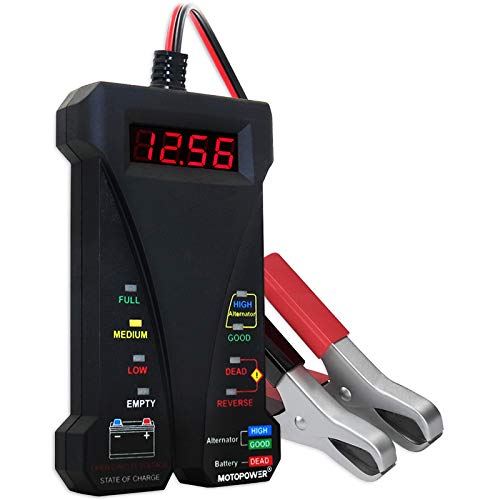
- ✓ Easy plug-and-test design
- ✓ Accurate digital readings
- ✓ Robust safety protections
- ✕ Limited to 12V batteries
- ✕ No smartphone connectivity
| Voltage Measurement Range | 4 to 20V DC |
| Display Type | 4-digit digital LCD |
| Voltage Testing Accuracy | ±0.01 volts |
| LED Indicators | 8 colored LEDs for battery and alternator status |
| Protection Features | Reverse connection and over-voltage protection |
| Connection Cables | 50cm extension cable with 30A alligator clips |
The moment I pulled the MOTOPOWER MP0514A out of its box, I was struck by how sleek and compact it feels in your hand. Its matte black rubber-coated surface gives it a solid, non-slip grip, making it comfortable to hold even during longer tests.
With just a simple plug into the battery, I was immediately impressed by how straightforward it is to use—no complicated buttons or setup needed.
Connecting the alligator clips was a breeze, thanks to the generous 50cm extension cable that offers plenty of flexibility. The device’s bright, 4-digit LCD display lit up instantly, showing voltage readings down to 0.01 volts—super precise for such a tiny tool.
I appreciated the 8 colored LED indicators that instantly told me if my battery was healthy or if the alternator was charging correctly.
What really stands out is its safety features. Even if I accidentally connected the clips the wrong way, the reverse connection protection kicked in without a fuss, preventing any sparks or damage.
The over-voltage protection also kept everything safe, making me more confident to test without worry. Whether checking the battery before a road trip or diagnosing a startup problem, this tester gives quick, reliable results.
Overall, it feels durable yet lightweight, perfect for keeping in your car or toolbox. Its simple, no-nonsense design means you don’t need to be a mechanic to get accurate info fast.
It’s a handy gadget that’s likely to save you time and stress whenever your car acts up.
KONNWEI KW341 Battery Tester for 6V-24V Vehicles

- ✓ Easy to use and read
- ✓ Supports multiple battery types
- ✓ Includes system testing
- ✕ Limited to 24V systems
- ✕ No internal batteries
| Voltage Compatibility | 6V, 12V, and 24V systems |
| Battery Capacity Range | 10-2000 CCA (Cold Cranking Amps) |
| Supported Battery Types | Flooded, AGM (flat plate & spiral wound), Gel, EFB, Lithium |
| Display | Backlit LCD with 12 language options |
| Additional Tests | Cranking and charging system diagnostics, internal resistance, ripple detection |
| Power Source | Powered directly by the vehicle battery (no internal batteries required) |
The first time I held the KONNWEI KW341 in my hands, I immediately appreciated its sturdy, compact design. The heavy-duty copper clamps felt solid and reassuring, and the backlit LCD screen was bright enough to read easily even in dim garage lighting.
I decided to test it on my car’s battery that looked fine but had been giving me occasional starting issues.
Connecting the clamps was straightforward, thanks to their firm grip. I powered up the device, and within seconds, it displayed a clear set of results.
The screen showed the battery’s State of Health and Charge, along with internal resistance and CCA measurements. It’s almost shocking how much you learn from a simple, quick test — no more guesswork about whether to replace or recharge.
What really impressed me was the inclusion of cranking and charging system tests. I ran the starter test, and the KW341 accurately measured the minimum voltage and duration, revealing that my starter motor was healthy.
The alternator test showed a steady output, confirming the battery’s issue wasn’t related to charging. The process felt intuitive, and the device’s safety features like reverse polarity protection kept me confident I wouldn’t fry anything.
Using this tester felt like having a professional mechanic in your garage. It supports a wide range of batteries, from motorcycles to heavy-duty trucks, and covers different standards.
Plus, the software updates and waveform display add a layer of tech-savvy convenience I really appreciated. For $34.99, you get a tool that’s both easy to use and genuinely helpful in preventing those frustrating breakdowns.
What Features Should You Consider When Choosing a Home Car Battery Tester?
When choosing the best home car battery tester, several features are essential to ensure accurate readings and ease of use.
- Accuracy: A reliable battery tester should provide precise voltage and health readings to help you assess the condition of your car battery effectively.
- Type of Battery Compatibility: Ensure that the tester can handle various battery types, including lead-acid, AGM, and gel batteries, to accommodate different vehicles.
- Ease of Use: Look for a user-friendly interface with clear instructions and easy-to-read displays, which make it simpler for anyone to operate the tester.
- Portability: A compact and lightweight design allows for easy storage and transport, making it convenient to carry in your vehicle or store at home.
- Additional Features: Some testers come with extra functionalities such as temperature compensation, load testing, or charging system analysis, providing more comprehensive diagnostics.
- Durability: A well-built tester should be robust enough to withstand regular use and potential impacts, ensuring longevity and reliability.
- Price: Consider your budget while comparing different models, as a higher price doesn’t always guarantee better performance; finding a balance between cost and features is key.
Accuracy is crucial in a battery tester, as it directly affects your ability to gauge the health and charge of your battery. A tester should provide voltage readings within a small margin of error, which helps in making informed decisions about battery maintenance or replacement.
Type of battery compatibility ensures that the tester can be used across different vehicles, including those with specialized batteries. This versatility saves you from purchasing multiple testers for various battery types, streamlining your maintenance process.
Ease of use is important, especially for individuals who may not be familiar with testing equipment. A clear interface, intuitive controls, and visible readings contribute to a hassle-free experience when checking battery health.
Portability is an essential feature for those who might need to test batteries on the go or store their equipment compactly. A lightweight and compact design allows for convenience and easy access whenever needed.
Additional features can enhance the functionality of a battery tester, offering more insights beyond basic voltage readings. Features like load testing can help simulate real-world battery conditions, while temperature compensation ensures that readings are accurate regardless of environmental factors.
Durability is vital in ensuring that the tester can withstand the rigors of regular use, especially in a garage or workshop setting. A robust construction protects against drops and other potential damage, ensuring longevity and consistent performance.
Price is a significant consideration when selecting a battery tester, as it varies widely across models. It’s important to evaluate the features offered and select a tester that fits within your budget while still meeting your needs effectively.
What Are the Different Types of Home Car Battery Testers and How Do They Compare?
| Type | Functionality | Price |
|---|---|---|
| Digital Battery Tester Examples: Ansmann, Foxwell |
Provides precise voltage readings and health status of the battery. Compatible with lead-acid batteries. Advantages: Easy to use. Disadvantages: Limited to voltage readings. | $20 – $50 – Moderate pricing for basic to advanced features. |
| Load Tester Examples: Schumacher, OTC |
Tests battery performance under load; useful for assessing starting power. Compatible with lead-acid batteries. Advantages: Accurate load testing. Disadvantages: Can be cumbersome to use. | $30 – $70 – Typically higher due to additional testing capabilities. |
| Smart Battery Tester Examples: CTEK, FOXWELL |
Connects to mobile apps for detailed diagnostics and analysis. Compatible with multiple battery types. Advantages: Comprehensive data analysis. Disadvantages: Pricey and requires a smartphone. | $50 – $100 – Premium price for advanced features and connectivity. |
How Do Digital and Analog Battery Testers Differ in Functionality?
Digital and analog battery testers serve the same fundamental purpose of assessing battery health, but they do so in different ways.
- Digital Battery Tester: Digital testers provide a numerical readout of the battery’s voltage and often include additional features like state of charge, internal resistance, and health indicators.
- Analog Battery Tester: Analog testers use a dial and needle to indicate voltage levels and are typically simpler in design, often requiring a more manual interpretation of results.
The digital battery tester is known for its ease of use and accuracy, making it suitable for those who prefer quick readings without the need for extensive knowledge about battery mechanics. Many digital models also come with built-in diagnostics that can help identify potential issues beyond just voltage, offering a more comprehensive view of battery health.
On the other hand, the analog battery tester appeals to those who appreciate a classic, straightforward approach. While it may lack the advanced features of digital testers, the analog version is often more affordable and does not require batteries or a power source, making it a reliable option for quick checks in various conditions.
How Accurate Are Home Car Battery Testers for Regular Use?
The accuracy of home car battery testers can vary based on the type and quality of the tester used, but many provide reliable readings for regular use.
- Digital Battery Testers: These testers often provide precise voltage readings and can assess battery capacity with more accuracy than analog testers. They usually come with built-in features to interpret the results and indicate battery health, making them suitable for regular monitoring.
- Analog Battery Testers: While typically less expensive, analog testers can be less accurate due to their reliance on needle movements. They require careful interpretation and calibration, which can make them less reliable for quick assessments.
- Load Testers: These testers apply a load to the battery to measure its performance under stress. They are particularly useful for determining the battery’s ability to start the engine and can give a good indication of battery health, especially for older batteries.
- Multimeters: A multimeter can measure voltage, resistance, and current, making it a versatile tool for checking battery health. While they require some understanding to interpret readings accurately, they can provide a comprehensive view of battery conditions when used correctly.
- Smart Battery Testers: These advanced testers connect to smartphones or tablets and use apps to analyze battery health. They can provide detailed diagnostics and historical data, making them a good choice for tech-savvy users who want to keep track of battery performance over time.
What Price Range Should You Expect for Quality Home Car Battery Testers?
The price range for quality home car battery testers varies based on features and brand reputation.
- Basic Models ($20 – $50): These testers provide essential functionality for checking battery voltage and condition. They are typically easy to use, featuring simple LED indicators or basic LCD screens that display results, making them suitable for casual users who need quick checks without advanced features.
- Mid-Range Models ($50 – $100): These testers often include additional diagnostic capabilities, such as load testing and multi-voltage testing. They may feature more sophisticated displays and allow users to test different battery types, providing a more comprehensive assessment of battery health, which is useful for enthusiasts or those with multiple vehicles.
- Advanced Models ($100 – $200): Advanced testers come with a variety of features, including Bluetooth connectivity, detailed analysis reports, and compatibility with smart devices. These models are designed for serious users or professionals who require precise diagnostics and the ability to analyze battery performance over time.
- Professional Grade ($200 and above): These high-end testers are equipped with the most advanced technology, including capabilities for testing starter and alternator performance in addition to batteries. They are often used by automotive technicians and come with extensive warranty and support options, ensuring reliability and accuracy in demanding environments.
What Do User Reviews Reveal About the Most Popular Home Car Battery Testers?
User reviews provide critical insights into the effectiveness and reliability of home car battery testers. Analyzing feedback from various platforms highlights several key aspects:
-
Ease of Use: Many users praise testers like the NOCO BT52 for their intuitive interface, allowing even novices to conduct tests without difficulty. Customers often note that a clear LCD display enhances usability, especially in low-light conditions.
-
Accuracy: Accuracy is a common theme, with testers like the FOXWELL BT705 receiving accolades for providing precise voltage readings and health assessments. Users often report confidence in making decisions based on this data.
-
Durability: Reviews frequently mention the robust build quality of devices such as the Ansmann Energy 200. Users appreciate testers that can withstand frequent use and adverse conditions, ensuring longevity.
-
Versatility: Many testers offer additional features, such as the ability to test different battery types. The multimeter function integrated in some models, like the Schumacher SC1281, is highly valued by users who want multifunctional devices for various diagnostic tasks.
-
Portability: A compact design is favored by users who want easy storage and transportation. Products like the INNOVA 3721 score points for their lightweight and user-friendly carrying options.
These insights gleaned from user experiences collectively indicate the factors that contribute to a home car battery tester’s success and reliability in everyday use.
How Can You Properly Maintain Your Home Car Battery Tester for Long-Term Use?
Proper maintenance of your home car battery tester ensures accurate readings and extends its lifespan.
- Regular Cleaning: Keeping the tester clean is crucial to its performance. Dust, dirt, and corrosion can accumulate on the probes and connections, affecting the accuracy of the readings. Use a soft cloth and a mild cleaning solution to gently wipe the exterior and probes, ensuring they are free from debris before and after each use.
- Calibration Checks: Periodically calibrating your battery tester helps maintain its accuracy. Over time, the internal components may drift from their optimal settings. Following the manufacturer’s instructions, perform calibration checks regularly to ensure that your tester provides reliable measurements.
- Battery Maintenance: If your tester is powered by batteries, ensure they are replaced as needed to avoid inconsistent readings. Old or weak batteries can lead to inaccurate results. Store spare batteries in a cool, dry place to prolong their life and check the battery levels before each use.
- Proper Storage: When not in use, store your battery tester in a protective case or designated area to prevent physical damage. Extreme temperatures and humidity can affect the performance of electronic devices, so keep it in a cool, dry environment. This practice helps prevent internal corrosion and component wear.
- User Manual Reference: Always refer to the user manual for specific maintenance guidelines provided by the manufacturer. This manual often includes details on troubleshooting, parts replacement, and specific care instructions that can enhance the longevity of your tester. Following these recommendations ensures you are using the device correctly and keeping it in optimal condition.