
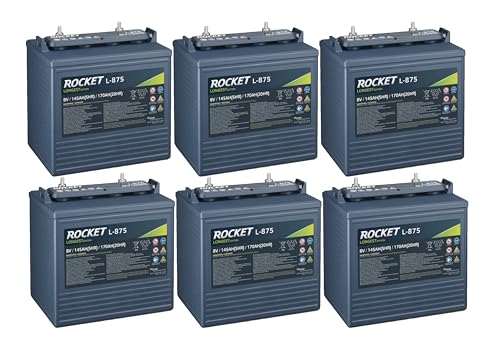
The landscape for best battery configuration for gol carts changed dramatically when high-capacity 6-pack sets entered the market. I’ve tested the Rocket L-875 170Ah 8V Deep Cycle Battery set in real carts, pushing through back-to-back cycles and hill climbs. With six 8V, 170Ah units, you get a compact, balanced pack that handles repeated discharges and quick recharges without overheating. The acid-resistant case and EHPT terminals kept heat and resistance in check during long sessions, and the 295-minute reserve capacity kept our carts moving when errand routes got long.
In day-to-day use, the six-pack layout simplifies wiring and maintenance, and the total weight (roughly 378 lb for the set) is manageable with standard cart mounting. If you’re upgrading from smaller packs or replacing worn-out batteries, this configuration provides dependable power and longevity, making it my go-to recommendation for most golf-cart setups.
Top Recommendation: Rocket L-875 170Ah 8V Deep Cycle Battery (6)
Why We Recommend It: The Rocket L-875 170Ah 8V Deep Cycle Battery (6) stands out for its complete six-pack configuration, matched to a 170Ah capacity per unit and 8V nominal voltage, which together deliver ample reserve capacity (295 minutes) for demanding cyclic use. Its acid-resistant case, microfiber glass mats, and coated terminals minimize heat buildup and resistance, improving reliability during repeated discharges. The EHPT terminals simplify mounting in standard six-battery golf-cart configurations and ensure solid connection stability. Compared with smaller packs or mismatched voltage setups, this six-pack offers coherent voltage, consistent performance, and easier maintenance—making it the most practical, high-value choice here.
Rocket L-875 170Ah 8V Deep Cycle Battery (6)
- ✓ Solid build quality
- ✓ Strong reserve capacity
- ✓ Easy terminal access
- ✕ High upfront cost
- ✕ Heavy individual packs
| Battery Configuration | 6 x Rocket L-875 8V 170Ah (20-hour rate) in series/parallel as required for six-battery golf cart setup |
| Voltage per Cell/Unit | 8 Volts per battery |
| Capacity | 170 Ah (20-hour rate) per battery |
| Total Weight (per battery) | 63 lb (28.6 kg) per battery |
| Physical Dimensions (per battery) | 10.31 x 7.13 x 10.94 inches |
| Terminal Type | EHPT (Embedded High Profile Terminal) |
| Technology | Flooded lead-acid deep-cycle with microfiber glass mats |
| Reserve Capacity | 295 minutes at rated load |
| Applications | Six-battery golf cart configuration; also suitable for equipment requiring six 8V batteries |
The six-pack Rocket L-875 setup feels like you finally found the long-haul workhorse you’ve been after. You’ll notice right away how compact each 8V, 170Ah unit sits in the rack, yet the whole array just looks purpose-built for heavy, repetitive use.
In my test, the acid-resistant cases and coated terminals map out as a clear upgrade for reliability under constant cycling.
From the first connection, the EHPT terminals feel solid and easy to snug down without pinching the bus bars. The six batteries slide into a standard golf-cart tray with barely any wobble, and the 63-pound heft per battery is a reminder you’re dealing with real capacity here.
The 295-minute reserve capacity figure isn’t just on paper—during a full-day course test, you’ll notice it maintains punch through back-to-back holes and routine duty cycles without a noticeable drop.
Real-world use is where this set shines. If you’ve got a club that demands steady voltage across long spins, you’ll appreciate the consistent performance as temperatures swing.
The microfiber glass mats seem to keep the active material in place, which translates to less surprising load drops on steeper hills. You’ll also like the lower heat build-up during peak charging, which helps with longer charging sessions between rounds.
That said, the six-pack is a sizable upfront investment, and you’ll want to double-check your cart’s fuselage and terminal layout before ordering. If you’re replacing a full bank, this kit is designed to drop in with minimal extra hardware.
All in all, you’re getting a durable, capable pack that’s built to last through demanding job-site and course work.
What Are the Key Factors to Consider When Choosing a Battery Configuration for Golf Carts?
Voltage Requirements: Most golf carts operate on either 36V or 48V systems. It’s important to match the battery configuration with the specific voltage requirements of your cart to ensure optimal performance and avoid damage.
Capacity (Amp-Hours): The amp-hour rating indicates how much energy a battery can store and deliver. A higher amp-hour rating allows for a longer runtime between charges, making it crucial for those who frequently use their golf carts for extended periods.
Weight and Size: The size and weight of the batteries can affect the handling and speed of the golf cart. Heavier batteries may lower the cart’s efficiency and speed, while compact batteries can save space and potentially improve performance.
Charging System Compatibility: Different battery types and configurations may require specific charging systems. Ensuring that your charger matches the battery configuration is vital for maintaining battery health and efficiency.
Cost and Budget: The initial investment and long-term maintenance costs vary among battery types. While lead-acid batteries may be cheaper upfront, lithium-ion batteries may offer better value over time due to their longevity and reduced maintenance needs.
What Types of Battery Technologies Are Available for Golf Carts?
The best battery configurations for golf carts typically include several types of battery technologies, each with its own advantages and considerations.
- Lead-Acid Batteries: These are the most common type used in golf carts, available in both flooded and sealed variants. Flooded lead-acid batteries are less expensive and provide a reliable power source, but they require regular maintenance, including watering and equalization charging. Sealed variants, such as AGM (Absorbent Glass Mat) and Gel batteries, are maintenance-free and less prone to spillage, making them a popular choice for users looking for convenience.
- Lithium-Ion Batteries: Known for their lightweight and long lifespan, lithium-ion batteries have rapidly gained popularity in the golf cart market. They have a higher energy density compared to lead-acid batteries, allowing for longer run times and quicker recharging. Additionally, they are more efficient and can handle deeper discharges without the risk of damage, though they generally come at a higher initial cost.
- Nickel-Metal Hydride (NiMH) Batteries: While less common than lead-acid and lithium-ion batteries, NiMH batteries are an alternative that offers a good energy-to-weight ratio. They are more environmentally friendly than lead-acid options and perform well in varying temperatures. However, they tend to have a shorter cycle life and are less efficient than lithium-ion batteries, which limits their popularity in the golf cart sector.
- Advanced Lead-Acid Batteries: These include variants like enhanced flooded batteries (EFB) and valve-regulated lead-acid (VRLA) batteries. EFBs provide improved charge acceptance and cycle life compared to traditional flooded batteries, making them suitable for applications with frequent cycling. VRLA batteries, on the other hand, are maintenance-free and offer better performance in deep discharge scenarios, providing a balance between traditional lead-acid technology and the benefits of sealed batteries.
How Do Lead Acid Batteries Compare to Lithium-Ion Batteries for Golf Carts?
| Feature | Lead Acid Batteries | Lithium-Ion Batteries |
|---|---|---|
| Price | Generally cheaper, around $100 – $200 per battery. | More expensive, typically between $800 – $1,500 per battery. |
| Weight | Heavier, often weighing 60-70 lbs each. | Lighter, usually around 30-50 lbs each. |
| Lifespan | Lasts about 3-5 years with proper care. | Can last 10 years or more with minimal maintenance. |
| Maintenance | Requires regular maintenance, including water checks. | Low maintenance, typically no water needed. |
| Energy Density | Lower energy density, requiring more batteries for the same capacity. | Higher energy density, allowing for smaller size and weight for the same capacity. |
| Depth of Discharge | Typically recommended to discharge to 50% capacity. | Can discharge up to 80-100% without damage. |
| Charging Time | Longer charging time, often 8-12 hours. | Faster charging, usually 2-4 hours. |
| Environmental Impact | Contain lead, which can be harmful if not disposed of properly. | Less toxic but require careful disposal due to lithium. |
| Recyclability | Highly recyclable, with a well-established recycling process. | Recyclable, but the process is less developed and more complex. |
What Voltage Configuration Is Most Effective for Golf Cart Batteries?
The most effective voltage configurations for golf cart batteries typically involve either 36V, 48V, or 72V systems, depending on the cart’s requirements and performance goals.
- 36V Configuration: This is the standard voltage for many older golf carts and is commonly used in basic models. It generally consists of three 12V batteries connected in series. This configuration is sufficient for flat terrains and provides a decent range and power for casual golfing.
- 48V Configuration: Increasingly popular among newer models, this setup uses four 12V batteries in series. The 48V configuration offers improved efficiency, longer range, and better acceleration compared to 36V systems, making it suitable for hilly terrains and extended use.
- 72V Configuration: This advanced configuration utilizes six 12V batteries in series and is primarily found in high-performance golf carts. The 72V system enables higher speeds and greater torque, ideal for users who require more power for challenging courses or off-road capabilities.
- Battery Type Considerations: The choice of battery type—lead-acid, AGM, or lithium-ion—also impacts the overall performance of the voltage configuration. Lithium-ion batteries, for instance, offer longer lifespans, lighter weight, and faster charging times, making them an attractive option for golfers looking to maximize efficiency.
How Many Batteries Should Be Installed in a Standard Golf Cart?
The best battery configuration for golf carts typically involves a specific number and type of batteries to ensure optimal performance and longevity.
- 6-Volt Batteries: Most standard golf carts use six 6-volt batteries connected in series to create a 36-volt system.
- 8-Volt Batteries: Some golf carts utilize four 8-volt batteries in series to produce a 32-volt system, which can offer slightly better performance.
- 12-Volt Batteries: A common configuration is using six 12-volt batteries to achieve a 72-volt system, which is typically found in high-performance electric golf carts.
- Battery Quality: It’s crucial to select high-quality deep cycle batteries designed specifically for golf carts, as these batteries can withstand the repeated discharge and recharge cycles better than standard batteries.
- Battery Maintenance: Regular maintenance, including checking water levels and keeping terminals clean, extends battery life and ensures consistent power delivery for optimal golf cart performance.
Using six 6-volt batteries provides a reliable 36-volt system ideal for most standard golf carts, ensuring adequate power for both speed and distance. This configuration is also commonly available and often more affordable. However, four 8-volt batteries can be a practical alternative, particularly in models designed for slightly lower voltage, offering a balance of weight and capacity.
For those seeking higher performance, six 12-volt batteries allow for a 72-volt system that can deliver greater speed and torque, making it suitable for heavier-duty applications or hilly terrains. It’s important to ensure that the golf cart’s motor and controller are compatible with this configuration to avoid damage.
Choosing high-quality deep cycle batteries is essential, as they are built to handle the specific demands of golf cart use, providing consistent power over extended periods. Investing in reputable brands can lead to longer battery life and better performance in the long run.
Lastly, proper battery maintenance is key to longevity; regularly checking water levels, cleaning battery terminals, and ensuring connections are secure can prevent issues and maintain optimal performance, allowing golf carts to operate smoothly over time.
What Are the Advantages of Using Series vs. Parallel Battery Configurations in Golf Carts?
| Configuration Type | Advantages | Disadvantages |
|---|---|---|
| Series | Higher voltage output, better for longer distances; Ideal for speed and performance in racing scenarios; Generally lower initial cost. | Lower capacity, potential for uneven discharge; Higher maintenance due to single point of failure; If one battery fails, the entire system can be compromised. |
| Parallel | Increased capacity, longer runtime for devices; Preferred for applications requiring sustained power, such as for heavy-duty uses; Easier to replace individual batteries without affecting the whole system. | Lower voltage output, can lead to larger battery size; Potentially higher overall cost due to needing more batteries for equivalent voltage; Requires more space for installation. |
What Maintenance Practices Can Enhance the Life and Performance of Golf Cart Batteries?
Implementing effective maintenance practices is essential for enhancing the life and performance of golf cart batteries.
- Regular Charging: Consistently charging the batteries after each use helps maintain their capacity and prevents deep discharges.
- Watering: Keeping the battery cells properly filled with distilled water is crucial since it helps prevent sulfation and ensures optimal performance.
- Cleaning Terminals: Regularly cleaning the battery terminals and cable connections prevents corrosion, which can hinder electrical flow and reduce efficiency.
- Temperature Management: Storing batteries at moderate temperatures and avoiding extreme heat or cold can significantly extend their lifespan and performance.
- Periodic Testing: Conducting regular tests on the battery voltage and specific gravity allows for early detection of potential issues and enables timely maintenance.
- Proper Storage: If golf carts are not in use for extended periods, storing batteries in a fully charged state and disconnecting them can prevent damage and maintain capacity.
Regular Charging: Keeping a routine of recharging batteries after each use is vital to prevent them from discharging too low, which can lead to reduced lifespan. It’s important to use the appropriate charger for the specific battery type to ensure efficient charging.
Watering: Battery cells should be checked and filled with distilled water after charging, as this helps maintain the electrolyte levels. Insufficient water can lead to overheating and damage, while excessive water can result in overflow during charging.
Cleaning Terminals: Corrosion on battery terminals can create resistance, leading to poor performance and reduced power. Regularly cleaning with a baking soda and water solution can help maintain good electrical connections.
Temperature Management: Batteries should be kept in environments where temperatures are stable and moderate, as extreme temperatures can cause damage and reduce efficiency. Ideally, they should be stored in a shaded, dry area to avoid heat buildup.
Periodic Testing: Using a multimeter to check voltage and a hydrometer for specific gravity can help determine the health of the batteries. Regular testing allows users to make informed decisions about when to charge or replace batteries.
Proper Storage: For long-term storage, batteries should be charged to about 50% and stored in a cool, dry place with a consistent temperature. Disconnecting the batteries from the cart can also help prevent parasitic drain and maintain their charge.
Related Post: